

Lindhos
Climbing a majestic crag that plunges into the cobalt blue of the Aegean, Lindos (or Lindhos) reveals itself to the traveler's eye...
Updated 7 July 2026
This season · July · Summer
What to do in Lindhos now
The story
The story of Lindhos
A history carved in rock and sea
The origins of Lindos are rooted in myth and in the maritime power of the 10th century BC, when the Dorians founded what would become one of the three great city-states of Rhodes, alongside Ialysos and Kameiros. Thanks to its strategic position and its two natural harbours, Lindos rapidly became a commercial emporium of prime importance in the eastern Mediterranean. It was here that the celebrated 'Rhodian Sea Law' was drafted, the basis of international maritime law. The city reached its zenith under the rule of the tyrant Cleobulus, one of the Seven Sages of antiquity, who in the 6th century BC promoted the rebuilding of the temple. With the founding of the city of Rhodes in 408 BC, Lindos lost political centrality but kept its religious prestige intact. In the following centuries, its rock became an impregnable fortress for Byzantines and Hospitaller Knights, who turned it into a bulwark against the Ottoman advance, leaving an indelible architectural imprint that fuses medieval rigour with classical elegance.
The Acropolis: the sanctuary between sky and sea
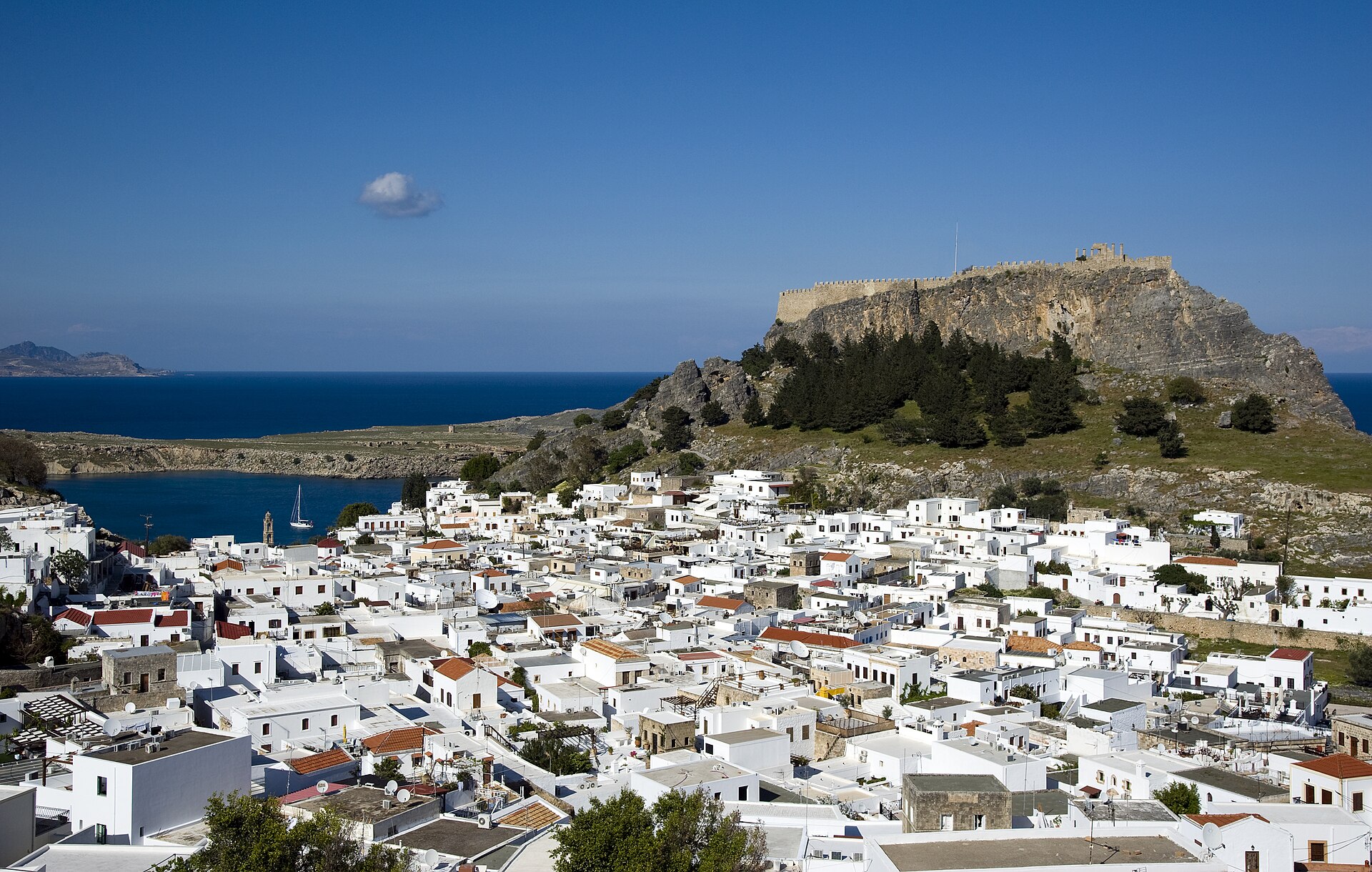
The Acropolis of Lindos is one of the most evocative archaeological sites in all of Greece, a natural pedestal 116 metres high that dominates the village and the coast. The climb to the summit is a rite of passage: a winding path gradually reveals the complexity of the site. Once at the top, visitors are greeted by a layering of structures that recount centuries of different rulers. The imposing fortified walls, rebuilt and expanded by the Knights of St John in the 14th century, enclose the remains of a glorious classical past. Here, the precision of Greek lines meets the massive medieval military architecture. The site is not just an open-air museum, but a privileged vantage point from which to admire the perfect geometry of the village below and the embrace of the surrounding bays, offering a visual synthesis of the power and spirituality that have characterized this place for millennia.
The Temple of Athena Lindia
The beating heart of the Acropolis is the Temple of Athena Lindia, a masterpiece of Doric order dating back to the 4th century BC, built upon the remains of a much older sanctuary. What makes this monument special, besides its dizzying position, is the elegance of its proportions. The columns still standing against the blue sky were once part of a complex that included a monumental propylon and a U-shaped stoa (colonnade), designed to welcome pilgrims with a sense of reverence and wonder. Athena Lindia was a deity venerated throughout the ancient world, and the temple housed precious offerings from every corner of the Mediterranean. Observing the base and the surviving columns, one can still sense the harmony between human craft and the wild nature of the cliff, a dialogue the Greeks knew how to weave with unsurpassed mastery.
The Castle of the Knights
Superimposed upon the ancient structures, the Castle of the Knights represents the legacy of the period when the Order of St John governed the island of Rhodes. This medieval fortress uses the acropolis as a strategic base, integrating the ancient Greek walls into a defensive system that was modern for its time. Inside, one can admire the remains of the Grand Master's palace and the Byzantine church of St John. An unmissable detail, located at the base of the staircase leading to the acropolis, is the relief of a Rhodian trireme from the 2nd century BC carved directly into the rock: a lasting tribute to the naval power of Lindos, which once served as the base for a statue. The castle is not merely a fortification, but a symbol of resistance that protected the local population during the numerous Ottoman sieges, testifying to the continuity of use of this rocky spur over the centuries.
The Church of the Panagia
Within the labyrinth of the village stands the Church of the Panagia (the Virgin Mary), the spiritual heart of the Lindos community. Originally built in the 13th century and later remodelled in 1475 by Grand Master Pierre d'Aubusson, this church is a jewel of Byzantine and post-Byzantine art. The exterior is marked by a red-brick dome and a finely decorated bell tower, but it is the interior that takes one's breath away: the walls are entirely covered with 18th-century frescoes by Gregory of Symi, depicting biblical scenes with extraordinary chromatic vividness. The floor is made with the typical 'chochlaki', a mosaic of black and white pebbles smoothed by the sea, creating geometric and floral patterns. Entering this church means immersing oneself in an atmosphere of ancient devotion, where incense and the dim light of candles enhance the beauty of the gilded icons.
The Captains' Mansions (Archontiko)
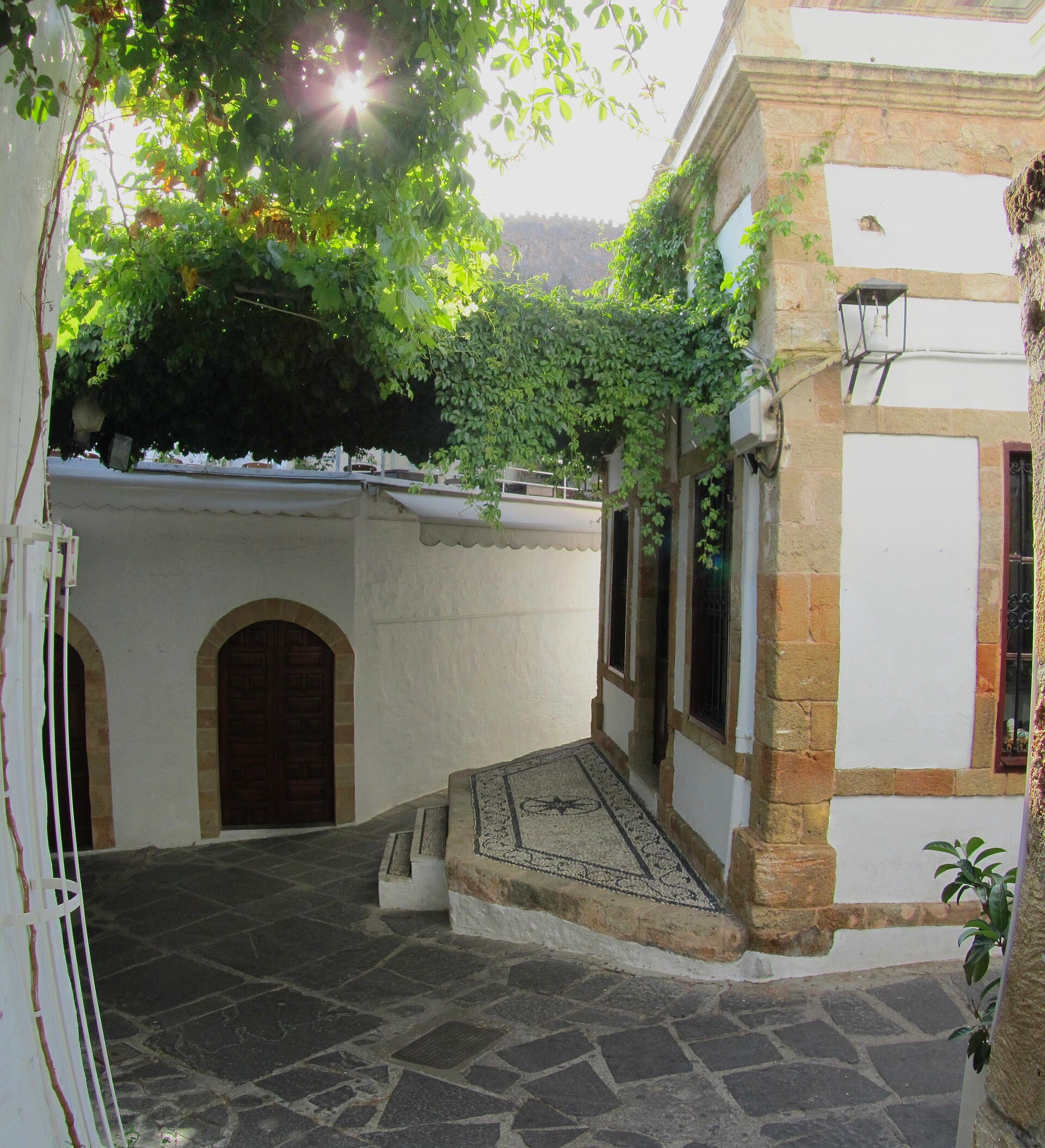
Strolling through Lindos, the eye is caught by imposing carved portals that stand out from the plain white houses: these are the 'Archontiko', the captains' houses. Built between the 17th and 18th centuries, these mansions bear witness to the wealth accumulated by Lindos's seafaring merchants. The architecture blends Gothic, Byzantine and Arab elements, with monumental entrances in finely worked local limestone. Inside, these houses conceal private courtyards decorated with pebble mosaics and spacious halls with painted wooden ceilings. The tall windows and austere façades served to protect the families' privacy and to display the owners' social status. Today many of these mansions have been transformed into boutique hotels or luxury restaurants, allowing visitors to admire the craftsmanship of the ancient master stonecutters who made Lindos's urban fabric unique.
St Paul's Bay: a perfect natural harbour
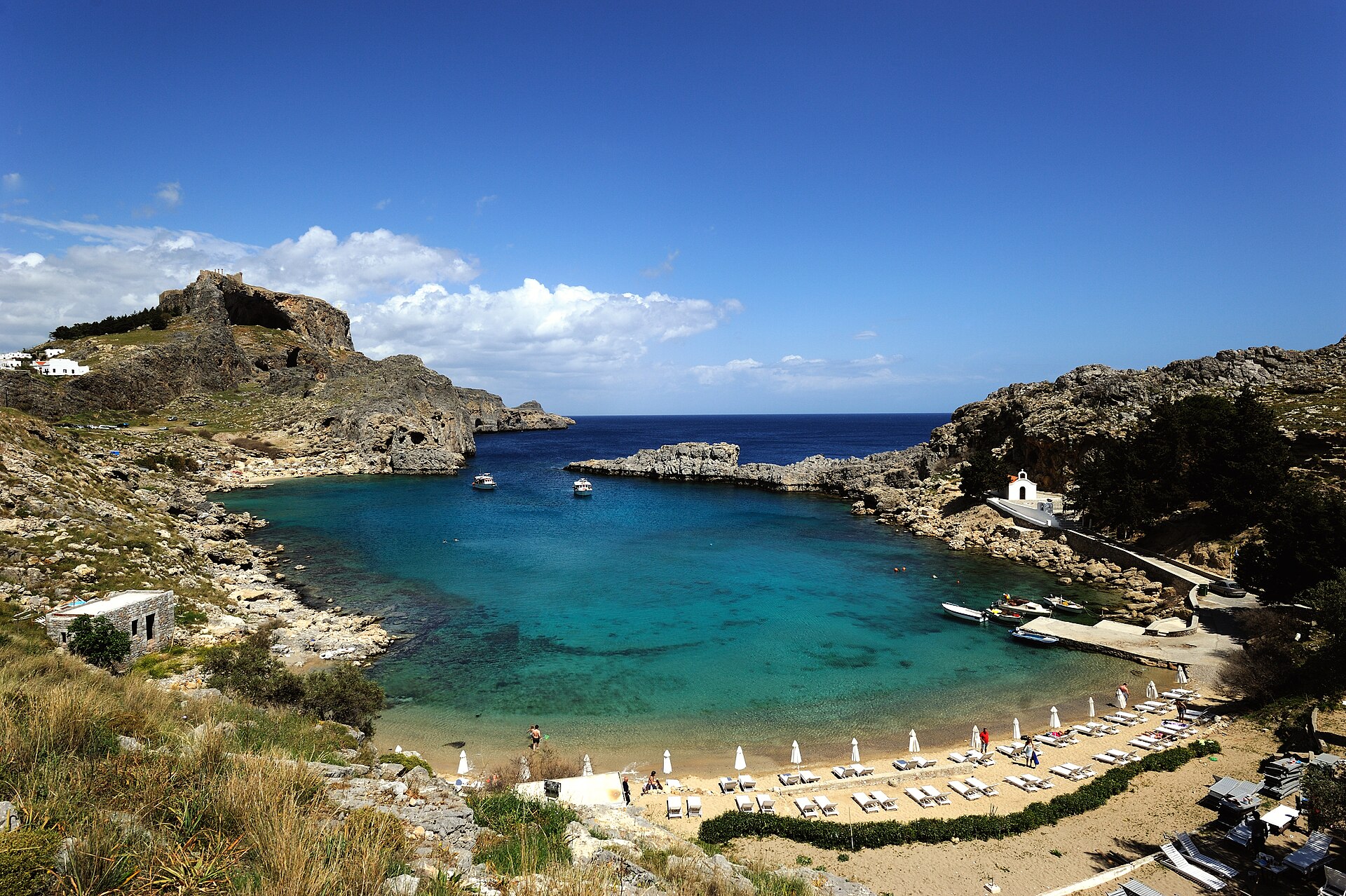
Located on the south side of the Acropolis, St Paul's Bay is one of the most photographed views in Greece. This almost entirely enclosed inlet, which from above appears heart-shaped, owes its name to the tradition that the Apostle Paul landed here in AD 57 to spread Christianity. The waters are calm, turquoise and incredibly clear, framed by golden rocks. On the shore stands a small white chapel, a favourite spot for romantic weddings. The bay offers two equipped beaches, yet retains a wild charm thanks to the rocky setting that surrounds it. It is the ideal place for snorkelling, since the rocky seabed hosts a rich marine fauna, and it represents the perfect refuge for those seeking a restorative pause after visiting the monuments, immersed in a natural scenery that seems to have stepped out of a painting.
Village architecture and town planning
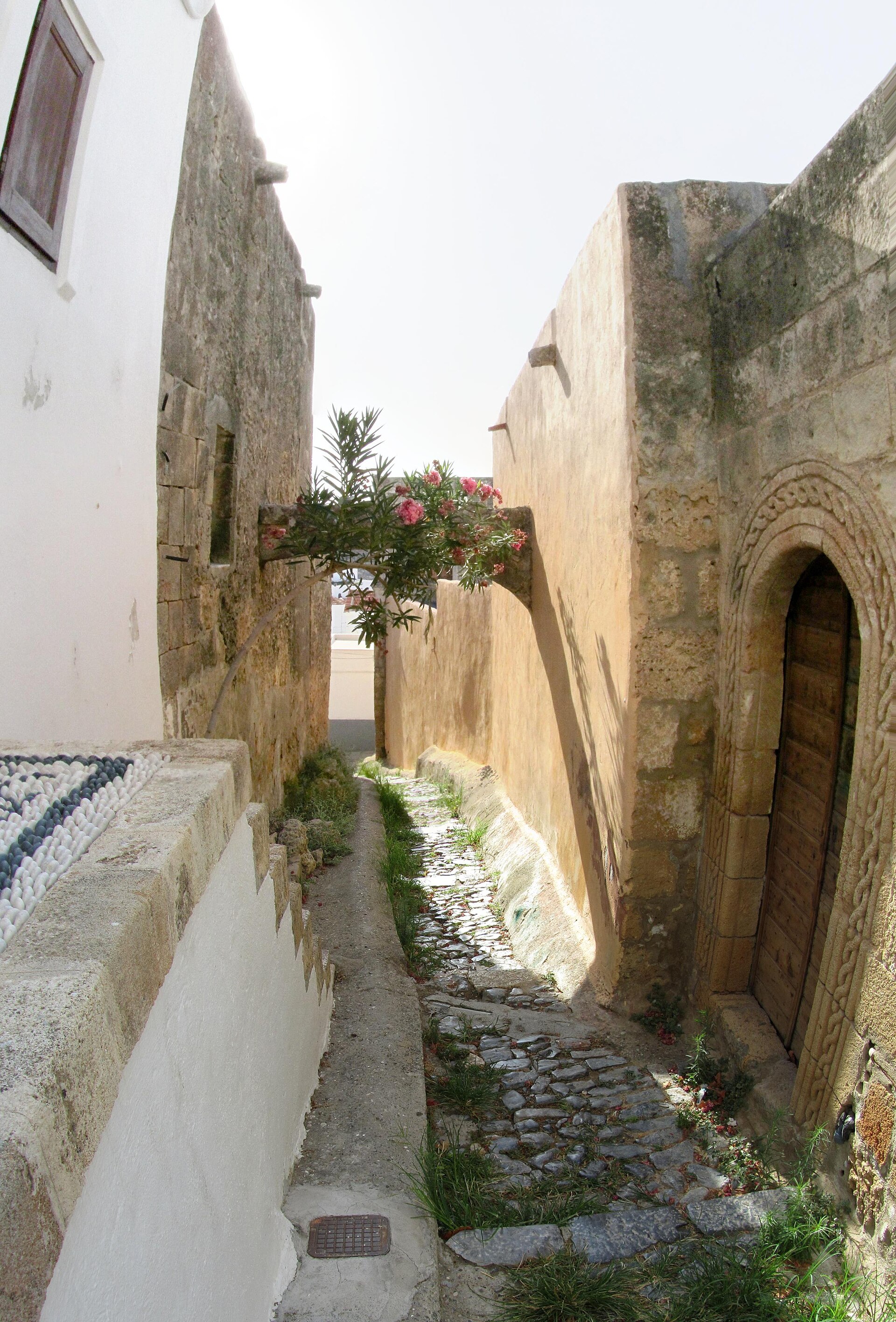
The village of Lindos is itself an open-air monument. Its narrow streets were deliberately designed to be winding and tight in order to confuse pirates who in the past tried to plunder the settlement. Today, this urban layout protects the village from car traffic, making it a pedestrian oasis. The houses, strictly whitewashed to reflect the summer heat, feature flat roofs and hidden internal courtyards. Every corner holds a surprise: an ancient fountain, a flowering hibiscus plant, or a fragment of a Greek column set into a modern wall. The attention to detail, such as the rainwater drainage channels or the decorated door thresholds, reveals a refined and proud popular aesthetic. Losing oneself among these alleys is the only way to grasp the essence of Lindos, discovering artisan ceramic workshops and small cafés where time seems to flow more slowly.
Landscape and Nature: between rocks and sea
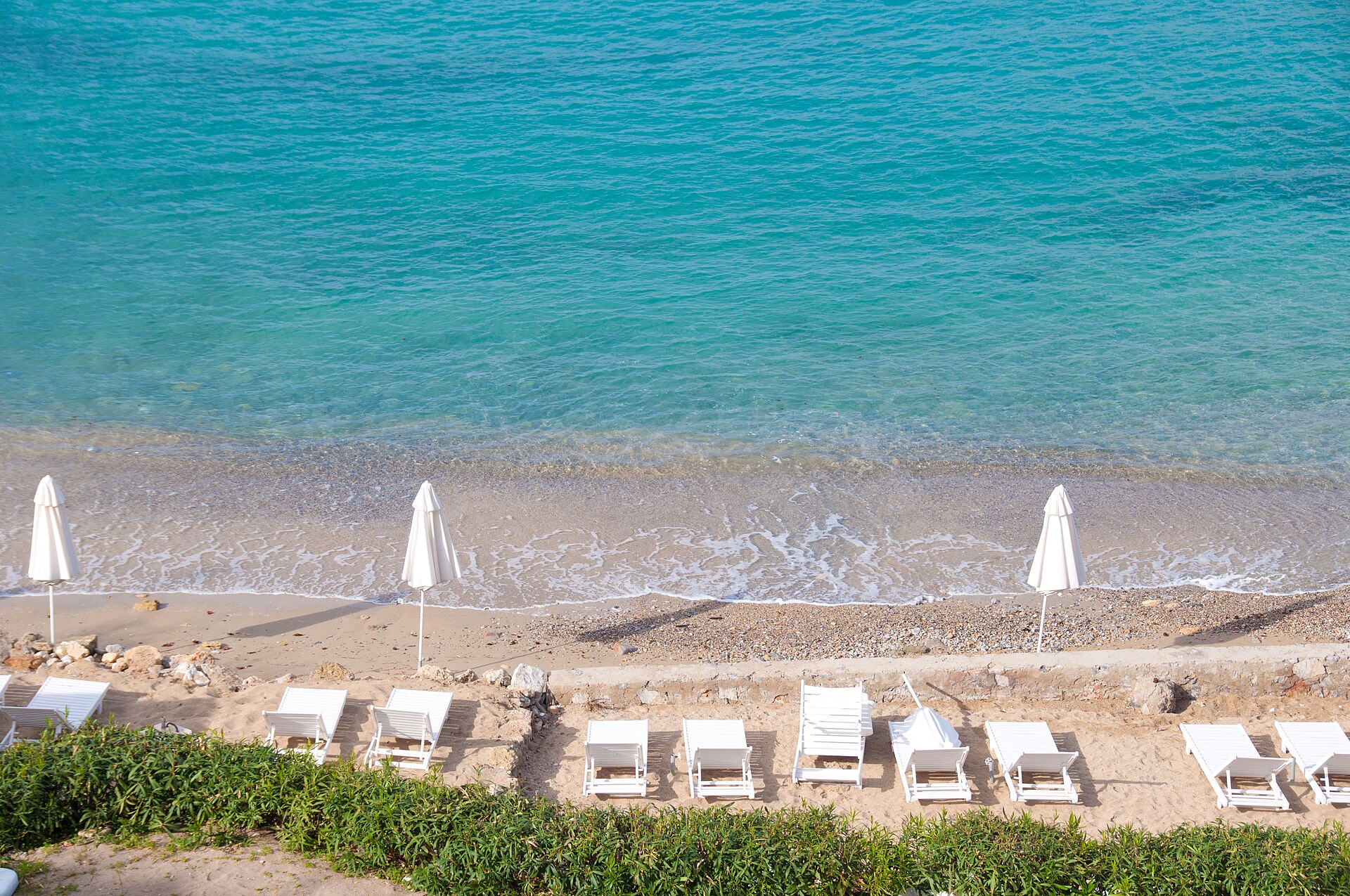
The landscape around Lindos is characterized by a rugged Mediterranean beauty. The hinterland is dominated by bare hills and centuries-old olive groves, while the coast alternates high cliffs with sandy bays. Besides St Paul's Bay, the main beach of Lindos (Megali Paralia) offers a wide stretch of fine sand with shallow waters, ideal for families. The chromatic contrast between the ochre of the rocks, the white of the village and the endless shades of blue of the sea creates a powerful visual impact. The vegetation is typical Mediterranean scrub, with aromatic herbs that perfume the air, especially in spring. For those who love walking, the surrounding area offers trails leading to secluded panoramic points, such as the Tomb of Cleobulus, a circular monument located on the promontory opposite the Acropolis, from which one enjoys a breathtaking view over the entire settlement.
Local traditions and flavours
The culture of Lindos is deeply linked to the land and the sea. One of the most vibrant traditions is the production of ceramics decorated with floral and marine motifs, a technique dating back to the period of the Knights. The local gastronomy reflects the richness of the island of Rhodes: not to be missed are the 'pitaroudia' (chickpea or tomato fritters), grilled octopus and dishes based on freshly caught fish. A key ingredient is the local olive oil, often accompanied by thyme honey produced in the nearby hills. Traditional sweets, such as 'melekouni' (a sesame and honey bar), are still prepared following recipes handed down from generation to generation. Dining on one of the many panoramic terraces of the village, with the illuminated Acropolis watching from above, is a sensory experience that unites taste with the scenic beauty of the place.
- Climbing to the Acropolis at opening time to enjoy the morning light and the silence.
- Visiting the Church of the Panagia and admiring its breathtaking frescoes.
- Taking a swim in the calm, sacred waters of St Paul's Bay.
- Seeking out the portals of the ancient Captains' Houses within the maze of the village.
- Admiring the relief of the Rhodian trireme carved into the rock at the entrance of the Acropolis.
- Enjoying a traditional dinner on a terrace overlooking the illuminated rock.
- Walking to the Tomb of Cleobulus for an alternative panoramic view.
When to go and how to experience Lindos
The best time to visit Lindos is spring (April-June) or early autumn (September-October). In these months the climate is mild, perfect for walking excursions, and the village is not yet crowded by the great summer tourist flows. July and August can be very hot, with temperatures often exceeding 35 degrees, making the climb to the Acropolis strenuous during the midday hours. To experience Lindos at its best, the advice is to stay in the village for at least one night: when the day-trippers head back to Rhodes Town, the village regains its magical quiet and the alleys are bathed in a soft light. It is the ideal moment for a night stroll, when the white of the houses gleams under the moon and the atmosphere becomes purely evocative.
FAQ
Come si raggiunge l'Acropoli?
È possibile circolare in auto nel villaggio?
Quanto tempo occorre per visitare Lindos?
Lindos è adatta ai bambini?
Cosa comprare come souvenir tipico?
Getting there
- Aeroporto Internazionale di Rodi Diagoras (RHO) - circa 50 km
- Non sono presenti linee ferroviarie sull'isola di Rodi.
- Da Rodi città si percorre la strada statale Rodou-Lindou verso sud per circa 50 minuti.
- I bus pubblici (KTEL) partono frequentemente da Rodi città e sono un'ottima alternativa economica all'auto.
Perfect for
Un sito unico al mondo dove templi dorici e fortezze medievali convivono su una rupe spettacolare.
Baie spettacolari come quella di San Paolo offrono acque cristalline e scenari naturali da cartolina.
Il villaggio è un esempio perfetto di architettura vernacolare bianca con influenze bizantine e nobiliari.
To see
