

Kolimbia
Picture a long straight line, an avenue of shade and fragrance that cuts through Rhodes' coastal plain for more than two kilometre...
Updated 7 July 2026
This season · July · Summer
What to do in Kolimbia now
The story
The story of Kolimbia
The origins: from the San Benedetto project to Kolymbia
Kolymbia's history diverges radically from that of neighbouring towns. It has no roots in classical antiquity, but was born during the period of Italian rule over the Dodecanese, in the 1930s. Originally named 'San Benedetto', the settlement was conceived as a model agricultural village. The Italian colonial government carried out a massive land-reclamation project in what was then a marshy and unhealthy area, turning it into a fertile agricultural colony intended for Italian settler families and locals. Farmhouses, a church, a school and an administrative centre were built following the canons of the rationalist architecture of the era. Only after Rhodes passed to Greece in 1947 did the village take on its current name of Kolymbia. This urban-planning legacy is still visible in the settlement's regular street grid and the layout of its spaces, which give the town an order and openness absent in the traditional villages of the interior.
The Avenue of the Eucalyptus Trees: a monumental entrance
The undisputed symbol of Kolymbia is the long, straight avenue linking the main coastal road to the heart of the seaside resort. Planted by the Italians during the founding of the village, this thoroughfare is flanked by hundreds of majestic eucalyptus trees that today form a natural tunnel of intense green. Beyond their aesthetic role, these trees were chosen for their ability to absorb large quantities of water from the ground, contributing decisively to the reclamation of the area. Travelling along this avenue, whether by car or on foot, is a sensory experience: the air suddenly cools and the balsamic scent of the leaves fills the surroundings. In the evening, the avenue lights up, creating an evocative atmosphere that guides visitors towards the sea, making the arrival in Kolymbia one of the most iconic moments of a trip to Rhodes.
The bays of Kolymbia and the fishermen's harbour
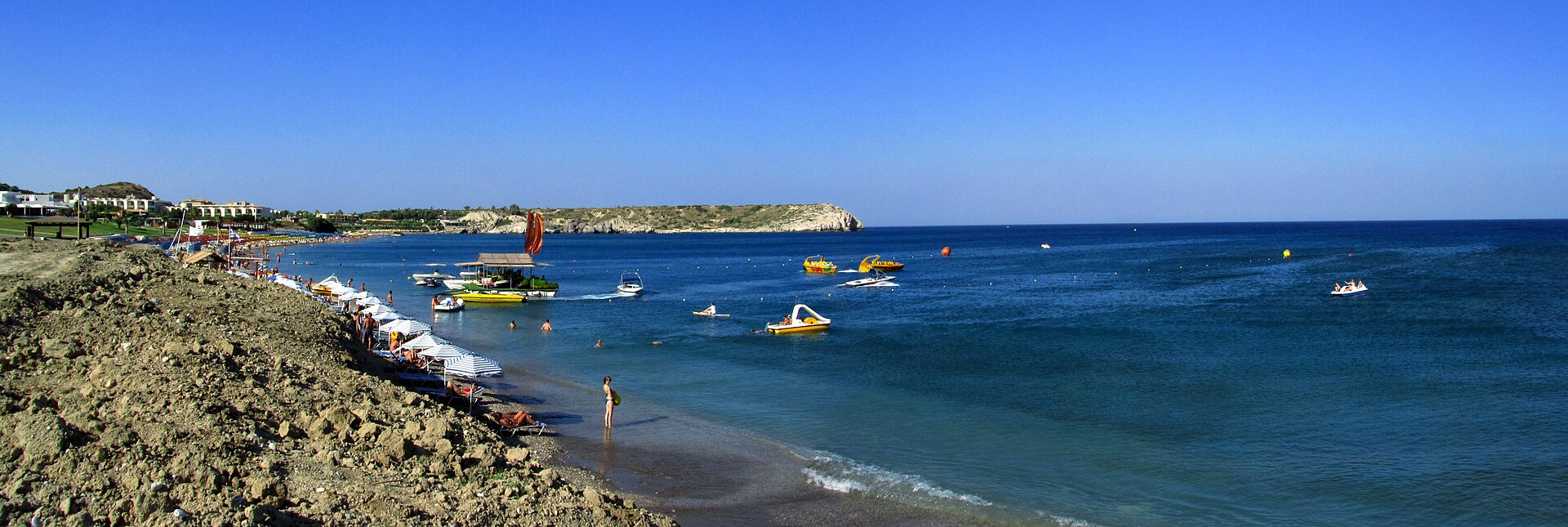
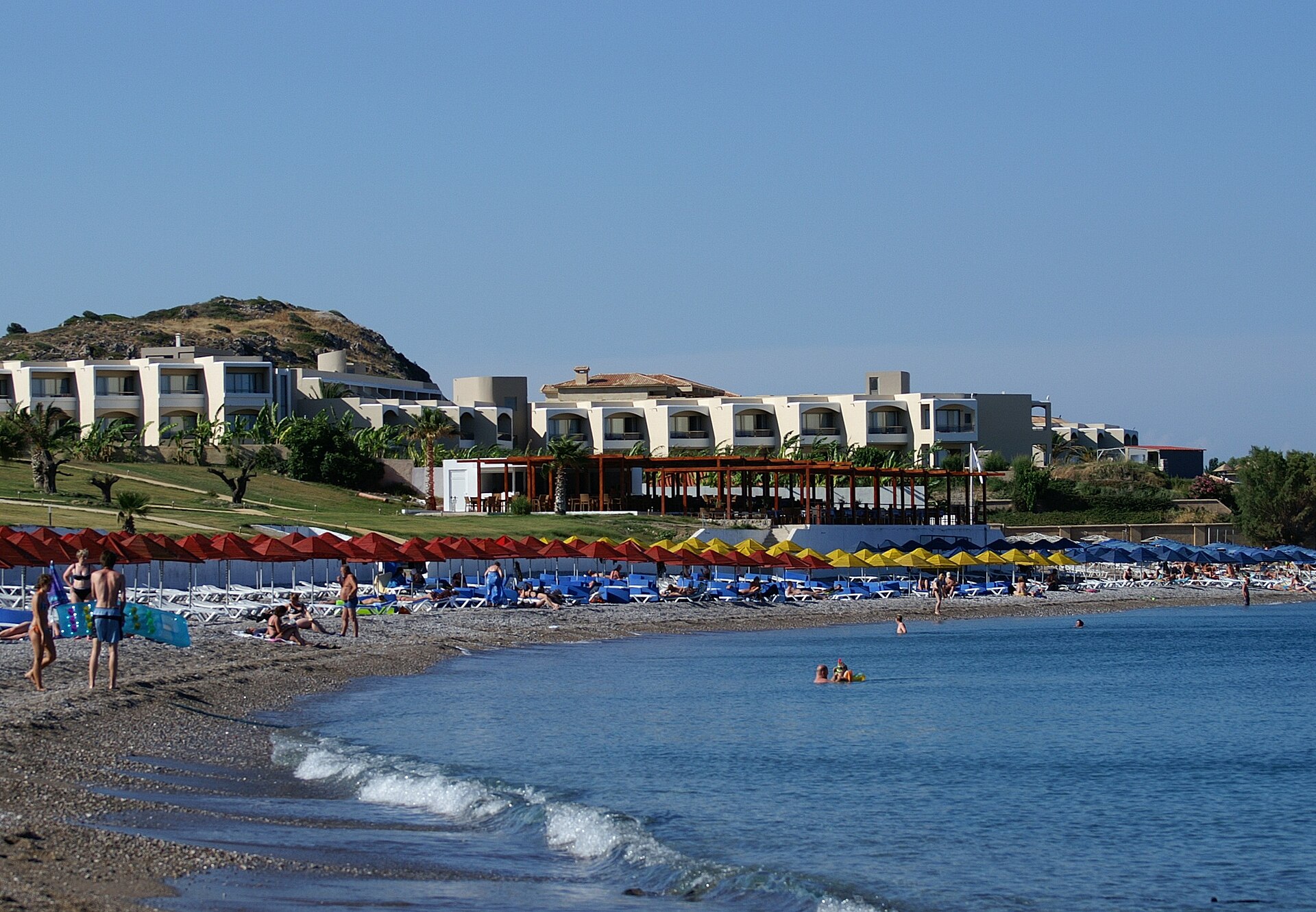
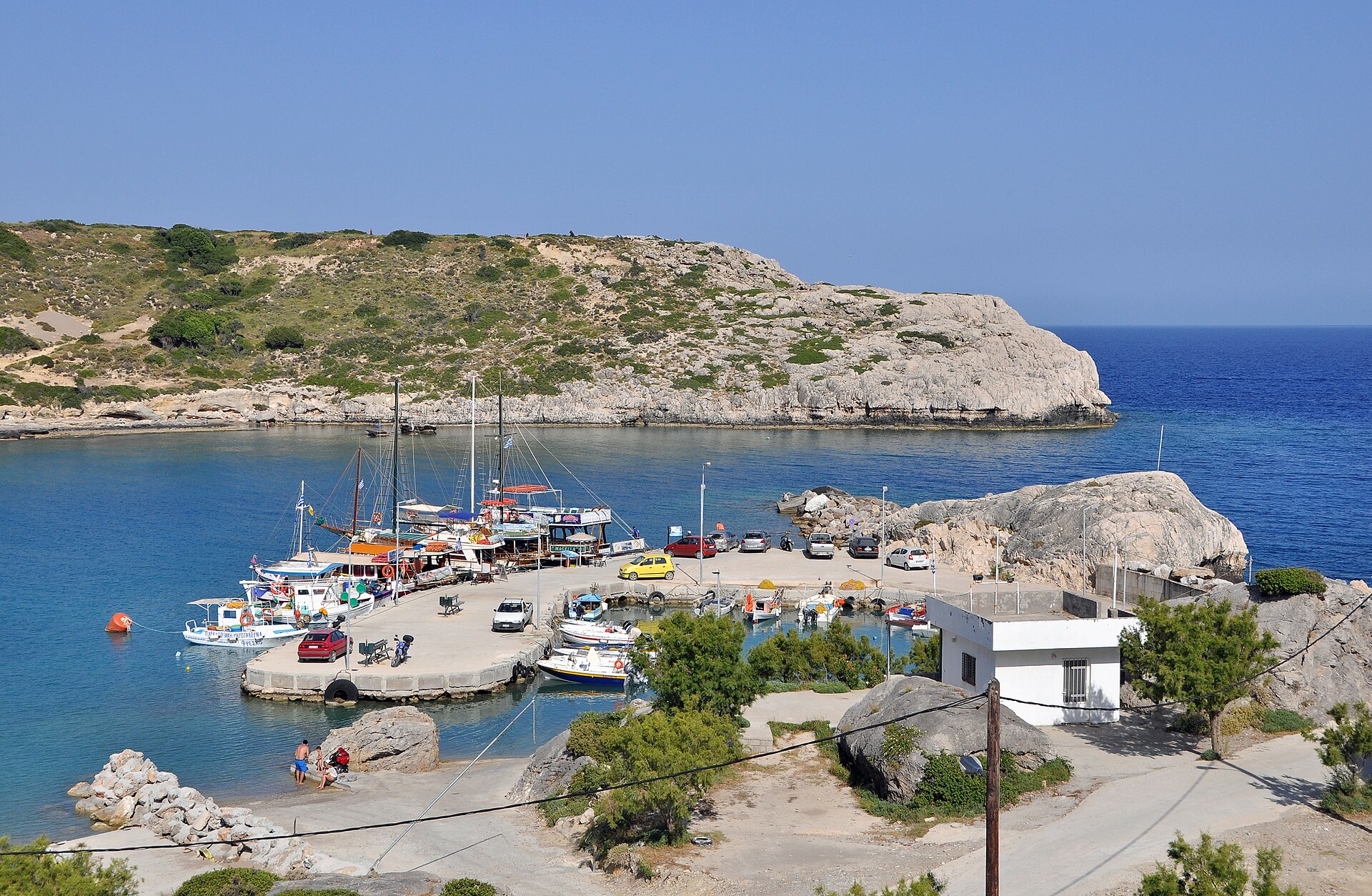
Kolymbia's coastline is mainly divided into two wide inlets separated by a rocky headland. The main beach is a mix of sand and small smoothed pebbles, washed by crystal-clear waters that shelve gently, making it perfect for families. On the northern side lies a small, picturesque little harbour where local fishing boats still moor today, alongside the boats that take tourists on excursions to the nearby sea caves. This area retains a more authentic character, with taverns overlooking the water where you can enjoy the day's catch. The shape of the bays often shelters the water from strong winds, guaranteeing ideal conditions for swimming and snorkelling along the cliffs that mark the edge of the coast.
The Monastery of Panagia Tsambika (Kato)
A short distance from the town centre stands the 'lower' monastery of Panagia Tsambika, a place of deep devotion for the island's inhabitants. This religious complex, characterised by the typical Dodecanesian architectural style with white walls and 'hokhlaki' floors (mosaics of white and black pebbles), is dedicated to the Virgin Mary. The monastery houses an icon considered miraculous, linked to ancient legends about fertility. The interior is rich with votive offerings and Orthodox decorations that tell of centuries of faith. It is a place of peace, surrounded by cypresses and well-tended gardens, where the silence is broken only by the tolling of bells. Every year in September, the monastery becomes the focal point of one of the most heartfelt religious celebrations on Rhodes, drawing pilgrims from every corner of the Dodecanese.
The climb to Kyra Psili: the upper Panagia Tsambika
For those undaunted by effort, a visit to Kolymbia cannot be considered complete without the climb to the old monastery perched atop the mountain overlooking the coast. Known as Kyra Psili, it is reached via a flight of around 300 steps that winds up through the pines. Legend has it that women wishing for a child climb up here barefoot to pray to the icon of the Virgin. Once at the summit, the effort is rewarded with one of the most spectacular panoramas on the whole island: the view sweeps from the golden beach of Tsambika below the mountain all the way to the coast of Turkey, visible on the horizon on clear days. The small white chapel at the top is a place of extraordinary spiritual energy, suspended between the blue of the sky and that of the sea.
Epta Piges: the oasis of the Seven Springs
Just four kilometres inland from Kolymbia lies Epta Piges, a true miracle of nature on Rhodes. In a region that is often arid, this site offers a lush landscape where seven freshwater springs converge to form a stream that flows all year round. The place is famous for an underground tunnel, also built during the Italian period, about 180 metres long, which channels the water towards a small artificial lake. More adventurous visitors can walk through the tunnel barefoot in the cool water (an experience not recommended for those who suffer from claustrophobia). Outside, shaded paths among plane trees and pines are home to peacocks living freely, making the area an unmissable destination for a refreshing break during the hottest hours of the day.
Tsambika Beach: gold and blue
Located just beyond the headland that closes off Kolymbia to the south, Tsambika Beach is considered one of the most beautiful on Rhodes. Unlike the typical pebbly coves of the area, here you'll find a long stretch of extremely fine, golden sand, framed by high rocky walls. The waters are a dazzling turquoise and remain shallow for many metres from the shore, making the beach a paradise for complete relaxation and for children's games. Despite being very popular, its size means you can always find a quiet spot. The beach is dominated from above by the monastery of the same name, which seems to watch over the bathers, and it offers various facilities for water sports, while still retaining a wild appearance at its extremities.
Landscape and Nature: between the sea and Mediterranean scrubland
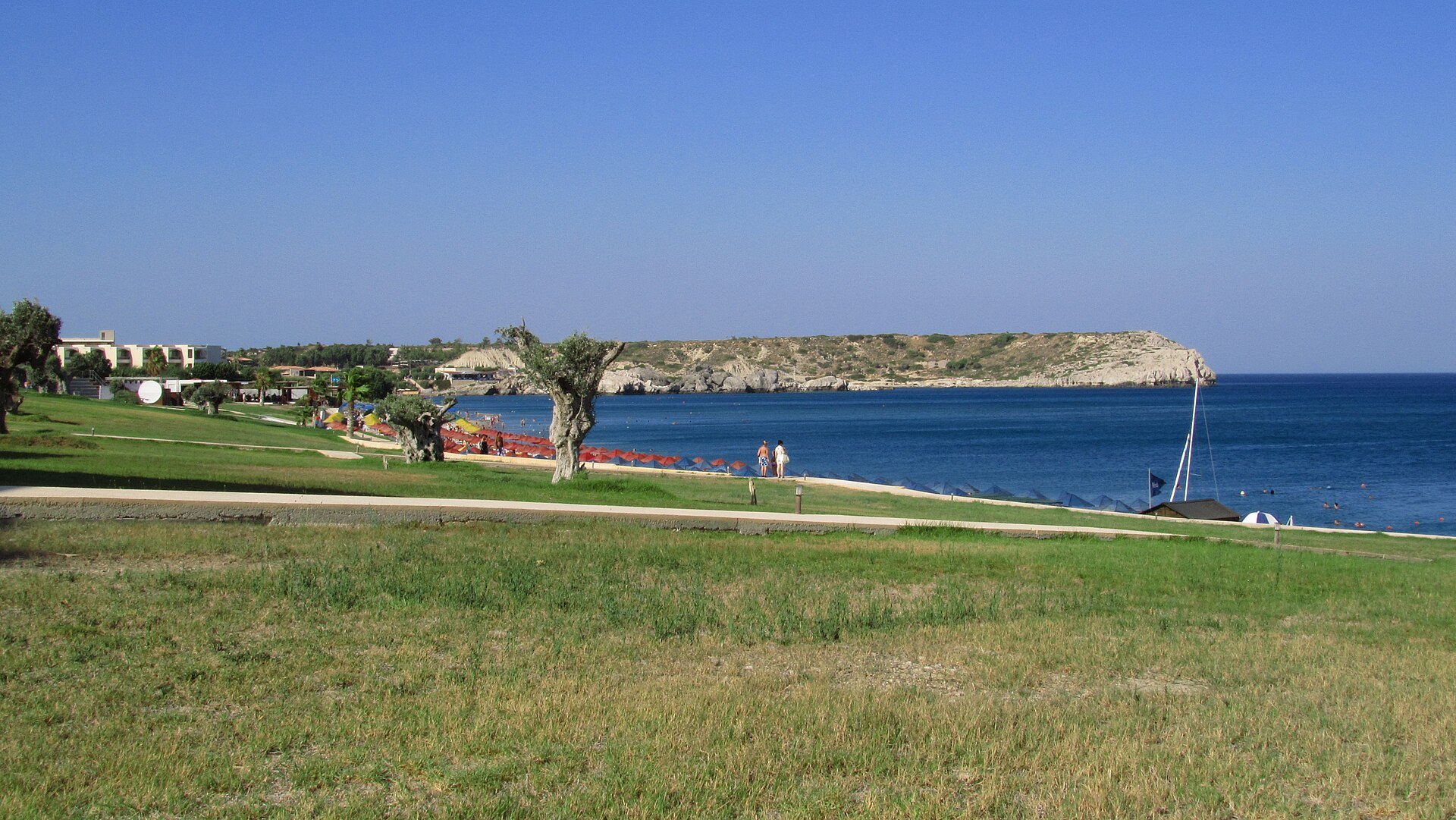
The area surrounding Kolymbia is a compendium of Aegean biodiversity. The coast is characterised by limestone formations that create small caves and hidden inlets, ideal for those with a boat or who love exploring the less-travelled stretches. Moving inland, the landscape changes rapidly: Mediterranean scrubland dominates the hills with mastic, myrtle and broom shrubs, which burst into colourful blooms in spring. The presence of fresh water nearby, as demonstrated by Epta Piges, favours the growth of vegetation that is unusually lush for these latitudes. This ecosystem is also a refuge for various species of birds and small reptiles, offering opportunities for birdwatching and short nature excursions that allow visitors to appreciate the island's wilder, quieter side.
Local traditions and flavours
Kolymbia's gastronomic culture reflects the island's dual soul: one linked to the sea, the other to the land. In the local taverns, fresh fish is the undisputed star, often prepared simply, grilled with oil and lemon or in the form of 'kakavia' (fish soup). Yet traditional peasant dishes are not lacking either, such as 'pitaroudia', chickpea or tomato fritters flavoured with local herbs, and 'melekouni', a typical sweet made from honey and sesame traditionally served at weddings. The proximity to the wine-producing areas of the interior also allows meals to be paired with excellent Rhodian wines, crisp whites or full-bodied reds, which benefit from the island's particular microclimate. Enjoying dinner at an open-air tavern under a starry sky is the best way to connect with Greek hospitality.
Experiences not to be missed
- Stroll along the Avenue of the Eucalyptus Trees at dawn to enjoy the fragrance and silence at their fullest.
- Rent a small boat at the harbour to explore the secluded coves north of Kolymbia.
- Climb the 300 steps to the upper Panagia Tsambika to admire the sunset over the Aegean.
- Walk through the water tunnel at Epta Piges for a refreshing thrill amid nature.
- Enjoy a lunch of grilled octopus and ouzo at a tavern overlooking the small bay.
- Visit the nearby village of Archangelos to discover the local craftsmanship of pottery and traditional boots.
When to go and how to experience Kolymbia
The best time to visit Kolymbia runs from May to October. May and June offer mild temperatures, spectacular blooms and absolute tranquillity, ideal for those seeking relaxation. July and August are the hottest and busiest months, perfect for those who love vibrant beach life and lively evenings, although the sea breeze ('meltemi') makes the heat bearable. September and October are perhaps the most magical months: the sea water is very warm, the light becomes softer and the resort regains a slower pace. Kolymbia should be experienced without haste, alternating sunny days on its beaches with excursions in the surrounding area. Its central location makes it the perfect base for exploring the island: within twenty minutes by car you can reach both the medieval town of Rhodes and the acropolis of Lindos, making it extremely easy to combine sea and culture.
FAQ
Kolimbia è adatta alle famiglie con bambini?
È necessario noleggiare un'auto?
Ci sono opzioni per la vita notturna?
Quanto tempo occorre per visitare Kolimbia?
Getting there
- Aeroporto Internazionale di Rodi Diagoras (RHO) - 30 km
- Percorrere la strada statale Rodi-Lindos verso sud; l'ingresso per Kolimbia è chiaramente segnalato dalla Via degli Eucalipti.
- Se arrivate in auto, parcheggiate lungo le strade laterali della Via degli Eucalipti o nei pressi del porto per evitare le zone più affollate.
Perfect for
Ideale per chi cerca baie tranquille, acque pulite e spiagge attrezzate senza il caos delle località più grandi.
Perfetta per escursioni brevi ma suggestive tra le Sette Sorgenti e la salita panoramica al monte Tsambika.
La base logistica migliore dell'isola per visitare comodamente sia il nord (Rodi città) che il sud (Lindos).
To see