

Ialisos
On the northwestern coast of the island of Rhodes, where the deep blue of the Aegean meets lush Mediterranean vegetation, stands I...
Updated 7 July 2026
This season · July · Summer
What to do in Ialisos now
The story
The story of Ialisos
A thousand-year chronicle: from its origins to the rule of the Knights
The history of Ialysos has its roots in myth and the most ancient archaeology. Already in the Minoan period, and later in the Mycenaean, the area was a crucial hub for maritime trade, as evidenced by the rich necropolises found nearby. With the arrival of the Dorians, Ialysos became one of the pillars of the Dorian Hexapolis, a commercial and religious confederation that dominated the southeastern Aegean. Its prestige did not fade even after the founding of the city of Rhodes: during the Byzantine era, its natural acropolis on Mount Filerimos was turned into an impregnable fortress. In the Middle Ages, the arrival of the Knights of the Order of St. John left an indelible mark on the architecture and spirituality of the place, transforming the classical remains into a center of Marian worship and a strategic military stronghold against Ottoman incursions.
Mount Filerimos: the acropolis of the spirit
The true historic heart of Ialysos beats at the summit of Mount Filerimos, a plateau located about 267 meters above sea level. This site is an extraordinary archaeological palimpsest where religious devotion has changed form but not substance over the millennia. It is reached via a tree-lined avenue leading to the remains of the ancient acropolis. The silence of the place, broken only by the rustle of wind through the cypresses and the calls of peacocks that roam freely on the hill, creates an atmosphere of suspended sacredness. It is the ideal starting point for understanding how Ialysos was, for centuries, a cultural and religious beacon for the whole island.
The Temple of Athena Polias and Zeus Polieus
Among the most significant classical ruins of Filerimos stand out the foundations of the temple dedicated to Athena Polias and Zeus Polieus, dating back to the 3rd-2nd century BC. Although today mainly the column bases and portions of the foundation remain, the original structure was an imposing peripteral Doric temple. This place was not just a center of worship, but the symbol of the sovereignty and political identity of the people of Ialysos. The choice to build the temple on the highest part of the mountain met the need for divine protection over the city and valley below. Walking among these ancient stones lets one sense the echo of a civilization that saw the bond between the divine and the landscape as the foundation of civic life.
The Monastery of Our Lady of Filerimos

Originally built by the Knights of St. John in the 14th century over a previous Byzantine church, the monastery is a sublime example of Gothic architecture applied to a Greek context. The structure was partially destroyed during the Ottoman occupation and skillfully restored by the Italians in the 1920s and 1930s. The cloister, with its pointed arches and lush inner garden, invites meditation. Inside, the icon of the Virgin of Filerimos was venerated, a Byzantine work considered miraculous, now kept at the National Museum of Montenegro, though a faithful copy remains on site. The adjoining church is unique of its kind, being divided into several chapels that served both Catholic and Orthodox rites, testifying to an ancient religious syncretism.
The Way of the Cross and the Giant Cross
From the monastery area begins the so-called 'Golgotha', a striking avenue lined with cypresses along which the Stations of the Cross, made with bronze bas-reliefs, are arranged. The path culminates in a square dominated by an imposing reinforced concrete cross, about 18 meters tall, rebuilt in the 1990s to replace the original from the Italian period. It is possible to climb inside the cross via a narrow spiral staircase to reach the horizontal arms, which serve as a panoramic balcony. From up here, the view spans 360 degrees: the gaze runs along the coast to Rhodes town, loses itself in the island's mountainous interior, and on clear days allows one to clearly make out the outlines of nearby islands and the Turkish coast.
The Doric Fountain
Along the slopes of the mountain, half-hidden by vegetation, lies one of the lesser-known yet most fascinating architectural gems of Ialysos: the Doric fountain from the 4th century BC. It is a monumental hydraulic structure, cut into the rock, which served to supply water to the ancient city. It features a portico with Doric columns that sheltered the cisterns and spouts, often decorated with lion heads. It is a rare example of ancient civil engineering still perfectly legible in its original function, demonstrating the technical refinement achieved by Rhodian builders in managing natural resources in an island environment.
The village of Trianta and the noble residences
At the foot of the hill lies Trianta, the modern heart of Ialysos. Although the main street is dominated by contemporary tourism, venturing into the inner streets reveals the charm of late 19th and early 20th century Rhodes. Here stand the 'pyrgoi', elegant tower houses and neoclassical villas surrounded by citrus gardens, built by wealthy Rhodian families as summer residences to escape the heat of the city. These homes, with their pastel colors and wrought-iron decorations, tell of an era of great economic and cultural ferment, when Ialysos was the resort of choice for the island's elite.
Coastal landscape and water sports
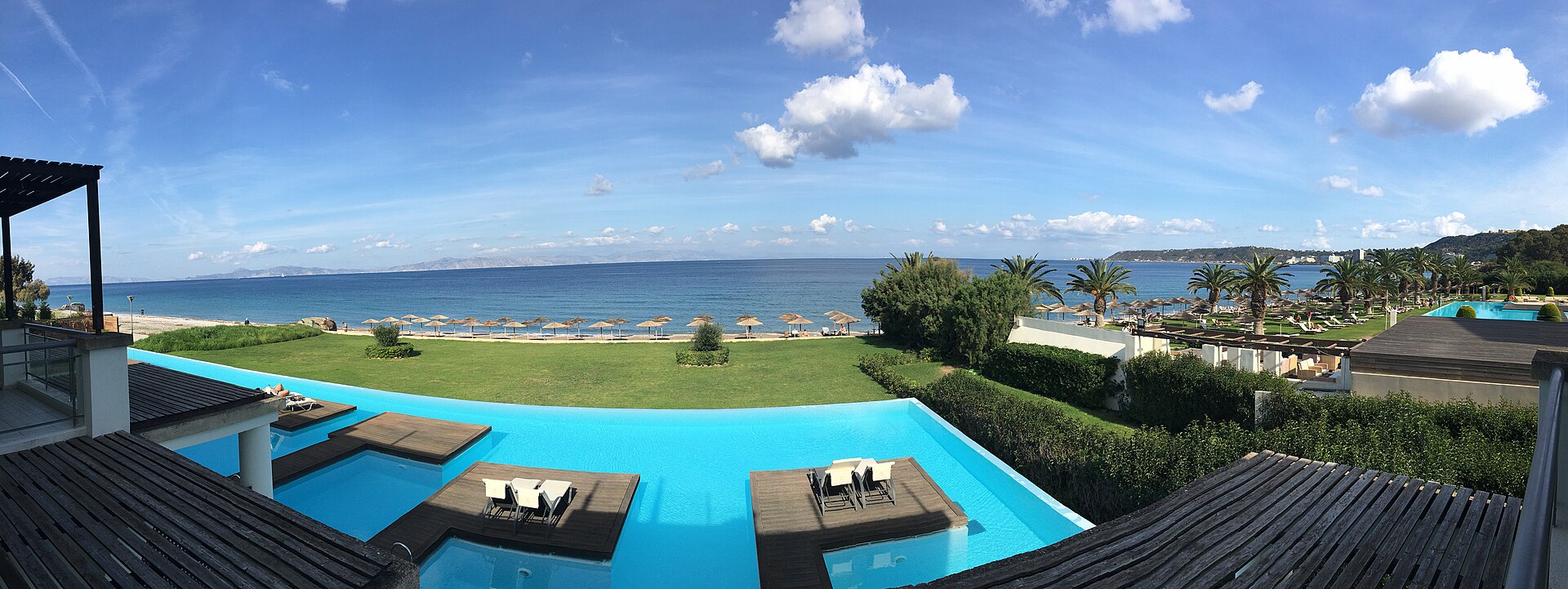
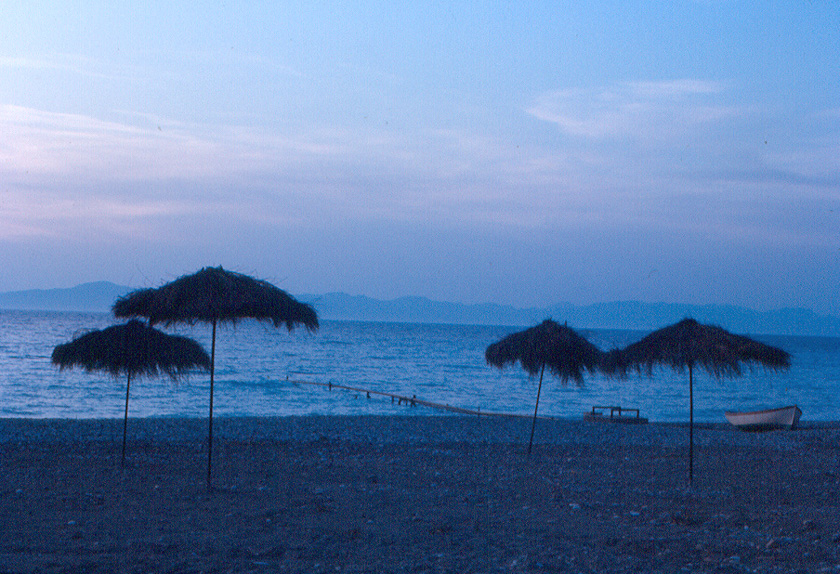
The beach of Ialysos is a long stretch of pebbles and sand washed by a crystal-clear sea that quickly deepens into rich blue. The main feature of this stretch of coast is its exposure to winds that blow steadily throughout the summer. This has made Ialysos one of Europe's capitals of windsurfing and kitesurfing, regularly hosting international competitions. Along the shoreline, specialized centers and schools follow one another, but there is also room for those seeking simple relaxation under a beach umbrella. Sunset walks along the water's edge are an unmissable experience: the sun disappearing directly into the sea creates spectacular plays of light, making the atmosphere romantic and melancholic at the same time.
Traditions and flavors: Seven Herbs liqueur
Ialysos preserves a unique liqueur-making tradition linked to the Filerimos monastery: the 'Seven Herbs' liqueur (Sette Herbe). The secret recipe, brought by Catholic monks during the era of the Knights and later perfected by Franciscan friars during the Italian administration, involves the infusion of seven different medicinal herbs gathered on the slopes of the mountain (including sage, thyme and wormwood). Today production continues following traditional methods, and the liqueur has become a symbol of local hospitality. In addition, Ialysos cuisine offers typical Dodecanese dishes, such as 'pitaroudia' (chickpea fritters) and the freshest fish served in the taverns overlooking the coast, where the simplicity of the ingredients enhances the flavors of the land.
Not-to-be-missed experiences in Ialysos
- Climb the cross on Mount Filerimos at sunset for an unrivaled view over the Aegean.
- Taste the Seven Herbs liqueur at the small kiosk run by the monks or local producers.
- Try windsurfing or kitesurfing, taking advantage of the perfect Meltemi conditions.
- Stroll among the peacocks that roam the gardens of the medieval monastery.
- Explore the inner streets of Trianta in search of hidden neoclassical villas.
- Visit the small underground church of St. George of Hostrakon with its 15th-century frescoes.
When to go and how to experience the place
The best time to visit Ialysos depends on the kind of experience you are looking for. For lovers of history and hiking, spring (April-May) is ideal: temperatures are mild, nature on Filerimos is in full bloom and the archaeological sites are uncrowded. For those seeking sea and water sports, high summer (July-August) guarantees the best winds, although the heat can be intense. Autumn, particularly September and early October, still offers warm waters and a more relaxed atmosphere. To experience Ialysos to the fullest, it is advisable to stay in the Trianta area for the convenience of its services, but to devote at least half a day to the silence of Mount Filerimos, preferably in the early morning hours to enjoy the slanting light that illuminates the ancient Doric stones.
FAQ
Quanto tempo occorre per visitare il sito di Filerimos?
La spiaggia di Ialisos è adatta alle famiglie con bambini?
È possibile raggiungere Ialisos con i mezzi pubblici?
C'è un parcheggio vicino al monastero di Filerimos?
Getting there
- Aeroporto Internazionale di Rodi 'Diagoras' (RHO) - circa 7 km
- Non presenti sull'isola
- Da Rodi città seguire la strada costiera verso ovest (Leoforos Ialisou) per circa 8 km. Per il monte Filerimos, svoltare all'incrocio segnalato nel centro di Trianta.
- Noleggiare uno scooter è il modo più agile per esplorare sia la costa che le strade tortuose che portano al Filerimos.
Perfect for
Un sito unico dove convivono resti ellenistici, bizantini e medievali in una stratificazione storica impeccabile.
Una delle destinazioni top in Grecia per il windsurf grazie all'esposizione costante ai venti stagionali.
L'atmosfera sospesa del monastero e il percorso del Golgotha offrono un'esperienza di pace profonda lontano dal caos costiero.
To see
