

Katerini
Nestled in a privileged position between the snow-capped peaks of Mount Olympus and the crystal-clear waters of the Thermaic Gulf,...
Updated 8 July 2026
This season · July · Summer
What to do in Katerini now
The story
The story of Katerini
Historical roots: between faith and transformation
The history of Katerini is a mosaic of influences layered over the centuries. Although traces of ancient settlements are numerous in the surrounding area, the modern city began to take clearer shape during the period of Ottoman rule, when it was known as Haterini. A defining turning point came in 1912, with the liberation of the city and its annexation to the Greek state, followed a few years later by the massive influx of Greek refugees from Asia Minor and Pontus after the population exchange of 1923. This event profoundly shaped Katerini's social and cultural identity, bringing new traditions, flavours and a work ethic that accelerated the region's post-war economic development. Today, the city presents itself as a proud custodian of its own past, capable of honouring the memory of its forebears through cultural institutions and monuments that recount a thousand-year-old resilience.
The Church of Agia Aikaterini: spiritual heart
The city's principal religious and symbolic landmark is the Church of Saint Catherine (Agia Aikaterini), located near the old cemetery. This sacred building, dating back to the 19th century, is not only a place of worship but also the keeper of the city's very name. Its architecture reflects the typical style of late-Ottoman-period Macedonian churches, with interiors richly adorned with wooden icons and frescoes that invite silence and contemplation. The community's devotion to its patron saint is expressed with particular intensity during the celebrations of 25 November, when the faithful gather in procession. Visiting this church means coming into contact with the deepest soul of Katerini, understanding how faith has for centuries been the identity-binding force of a population often forced to fight for its own freedom.
The Municipal Park: an urban oasis
A true green lung of the city, Katerini's Municipal Park is a masterful example of how public space can elevate the quality of urban life. Spread over several hectares, the park is characterised by lush vegetation, small pools of water, dancing fountains and pedestrian paths that invite long, rejuvenating walks. It is the place where families gather at weekends and where young people meet at the cafés dotting its edges. Throughout the year, the park becomes a natural stage for cultural events, open-air concerts and Christmas markets, becoming the centre of the city's social life. The care with which it is maintained testifies to the residents' love of nature, offering a cool, shaded refuge even during Macedonia's hot summer days.
Eleftherias Square: the city's living room

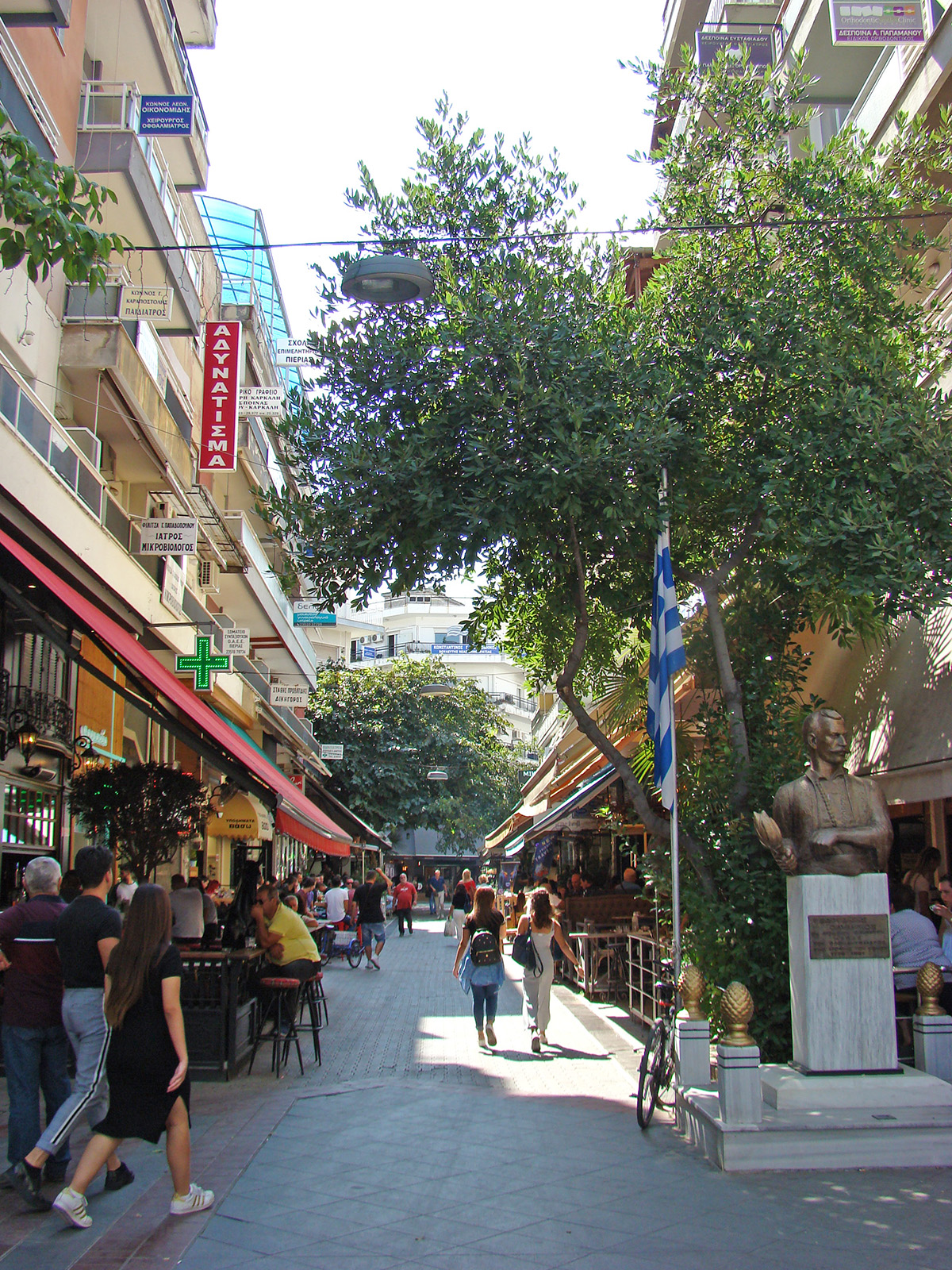
Eleftherias Square (Freedom Square) represents the nerve centre of Katerini, where the frenetic rhythm of commerce and social life beats. Surrounded by modern buildings, elegant shops and a multitude of cafés, the square is the ideal starting point for exploring the city centre. Here, the Greek ritual of coffee is savoured slowly, amid lively conversation and eyes turned to the passing crowds. The square is not merely a place of transit, but a symbol of the region's economic rebirth; its strategic position connects it to the main shopping streets, making it an essential stop for anyone wishing to immerse themselves in the city's daily atmosphere. In the evening, the carefully designed lighting and the buzz of the venues transform it into a lively setting, perfect for beginning an evening exploring the local nightlife.
Ancient Dion: the sacred city of the Macedonians
A few kilometres from Katerini lies the archaeological site of Dion, one of the most evocative places in all of Greece. An ancient sacred city dedicated to Zeus and the gods of Olympus, Dion was the religious centre of the Kingdom of Macedonia, where Philip II and Alexander the Great celebrated victories and offered sacrifices. The archaeological park is extraordinary because it unites monumental remains with a watery natural setting: the sanctuaries of Isis and Demeter literally emerge from spring-fed waters, creating a mystical, surreal atmosphere. Walking among the remains of the ancient theatre, the Roman villas with their splendid mosaics and the baths, one has the sense that time itself has stopped. The adjacent museum houses the Hydraulis, one of the world's oldest keyboard musical instruments, rounding out a cultural experience that alone makes the trip to this region worthwhile.
Platamon Castle: sentinel by the sea
Continuing along the coast southward, the imposing profile of Platamon Castle comes into view, a perfectly preserved Crusader and Byzantine fortress that dominates the Aegean Sea. Built in a strategic position to control the passage towards Thessaly, the castle boasts mighty walls and a central octagonal tower that rises against the blue sky. Within its fortified perimeter, one can admire the remains of ancient churches and dwellings, but it is the panoramic view that leaves visitors breathless: on one side the immensity of the sea, on the other the wooded slopes of Olympus. During the summer, the castle hosts the events of the Olympus Festival, transforming into an exceptional theatrical and musical stage, where the natural acoustics and the charm of history merge into unforgettable evenings beneath the stars of Macedonia.
Paralia Katerinis and the Olympic Riviera
Katerini's seaside face is found at Paralia, a coastal district just six kilometres from the centre. Characterised by a very long stretch of golden sandy beach and shallow waters, Paralia is one of the most popular tourist destinations in northern Greece. The seafront is an unbroken succession of hotels, seafood restaurants, fur boutiques (a local tradition) and nightspots that draw visitors from all over Europe. Despite its strong tourist character, Paralia's harbour retains an authentic charm early in the morning, when fishermen return with the day's catch. The nearby beach of Olympiaki Akti, connected by a pleasant cycling and pedestrian path, offers a slightly quieter atmosphere, ideal for those seeking relaxation without giving up the amenities of a modern seaside resort.
Mount Olympus: home of the gods
It is impossible to speak of Katerini without turning one's gaze towards Olympus, Greece's highest mountain and the country's first national park. Katerini is the preferred base camp for those wishing to explore this mythological massif, which offers unique biodiversity with over 1,700 plant species. The trails departing from nearby Litochoro lead through the Enipeas Gorge up to the peaks of Mytikas and Stefani, the throne of Zeus. Even for those who are not experienced hikers, Olympus offers enchanting scenery, monasteries perched on cliffs like that of Agios Dionysios, and waterfalls hidden among the pines. The mountain's presence shapes Katerini's climate, bringing cool evening breezes even in the height of summer and a visual backdrop that shifts with the seasons, from the pristine white of winter snow to the lush green of spring.
Traditions and flavours of Pieria
Katerini's cuisine is a happy union of the land's produce and the treasures of the sea. The Pieria region is famous for producing top-quality kiwis, cherries and chestnuts, often found in local markets. Traditional cheeses such as feta and manouri are always on the table, accompanied by the celebrated local tsipouro, a strong, fragrant spirit often flavoured with anise. In the tavernas of Paralia, fresh fish takes centre stage, simply grilled or cooked in a light stew, while inland, meat dishes such as souvlaki and kleftiko, slow-cooked in wood-fired ovens, reign supreme. One cannot leave Katerini without tasting the syrupy sweets typical of Macedonian tradition, a legacy of the Greek communities of Asia Minor, which end every meal on a note of sweetness and hospitality.
- Exploring the archaeological site of Dion early in the morning to enjoy the magical light among the ruins.
- Walking the trail through the Enipeas Gorge starting from Litochoro to admire the waterfalls of Olympus.
- Enjoying a sunset from the walls of Platamon Castle looking out over the Aegean Sea.
- Tasting fresh mussels from Makrygialos at one of the harbourside tavernas.
- Visiting the traditional village of Elatochori to discover the region's mountain and ski side.
- Strolling through Katerini's weekly market to buy local honey and spices.
FAQ
Qual è il periodo migliore per visitare Katerini?
Come ci si sposta tra la città e la spiaggia?
È una destinazione adatta alle famiglie?
Cosa vedere nei dintorni in un giorno?
Getting there
- Aeroporto di Salonicco-Macedonia (SKG) - circa 80 km
- Stazione ferroviaria di Katerini sulla linea principale Atene-Salonicco.
- Autostrada A1 (E75) che collega Salonicco ad Atene; Katerini ha diverse uscite dedicate.
- Il treno regionale da Salonicco è un'opzione economica e panoramica che impiega circa 45-60 minuti.
Perfect for
Porta d'accesso all'Olimpo, offre sentieri per ogni livello tra miti e biodiversità unica.
Vicina a Dion e Pydna, è il luogo perfetto per chi ama la storia del Regno di Macedonia.
La Riviera Olimpica offre chilometri di spiagge sabbiose attrezzate e acque pulite.
To see
Da vedere a Katerini
Routes · Trovido Route
