

Neokhoraki
Nestled in the beating heart of Corfu's southern region, Neokhoraki (or Neochoraki) reveals itself to the traveller as a jealously...
Updated 8 July 2026
This season · July · Summer
What to do in Neokhoraki now
The story
The story of Neokhoraki
A past between Byzantium and the Serenissima
The history of Neokhoraki is closely intertwined with the events of the Lefkimmi region and the whole island of Corfu. Although the current settlement reflects more recent development compared to the ancient Byzantine fortresses, the territory has been inhabited since antiquity, serving as a granary and olive grove for the powers that took turns controlling the Ionian Islands. During the long Venetian rule, which lasted over four centuries, the Neokhoraki area became a crucial centre for olive oil production, thanks to incentives from the Serenissima that transformed the landscape into an immense silvery expanse. This period left an indelible mark on the local architecture and social organisation of the village, which withstood pirate raids thanks to its slightly inland position, protected by the hills.
The Church of Agios Nikolaos: the heart of the community
The spiritual heart of Neokhoraki is represented by the church dedicated to Agios Nikolaos, patron saint of sailors and a central figure in Corfiot devotion. The building stands out for its typical Ionian style, characterised by a bell-gable tower rising above the village's red roofs. Inside, the church holds icons of fine craftsmanship, many dating back to the 18th and 19th centuries, testifying to the skill of local artists influenced by the Cretan-Venetian school. It is not just a place of worship but the centre of social life: the church courtyard still hosts the community's main events today, keeping alive a tradition of gathering rooted in centuries past.
Rural architecture and the village lanes
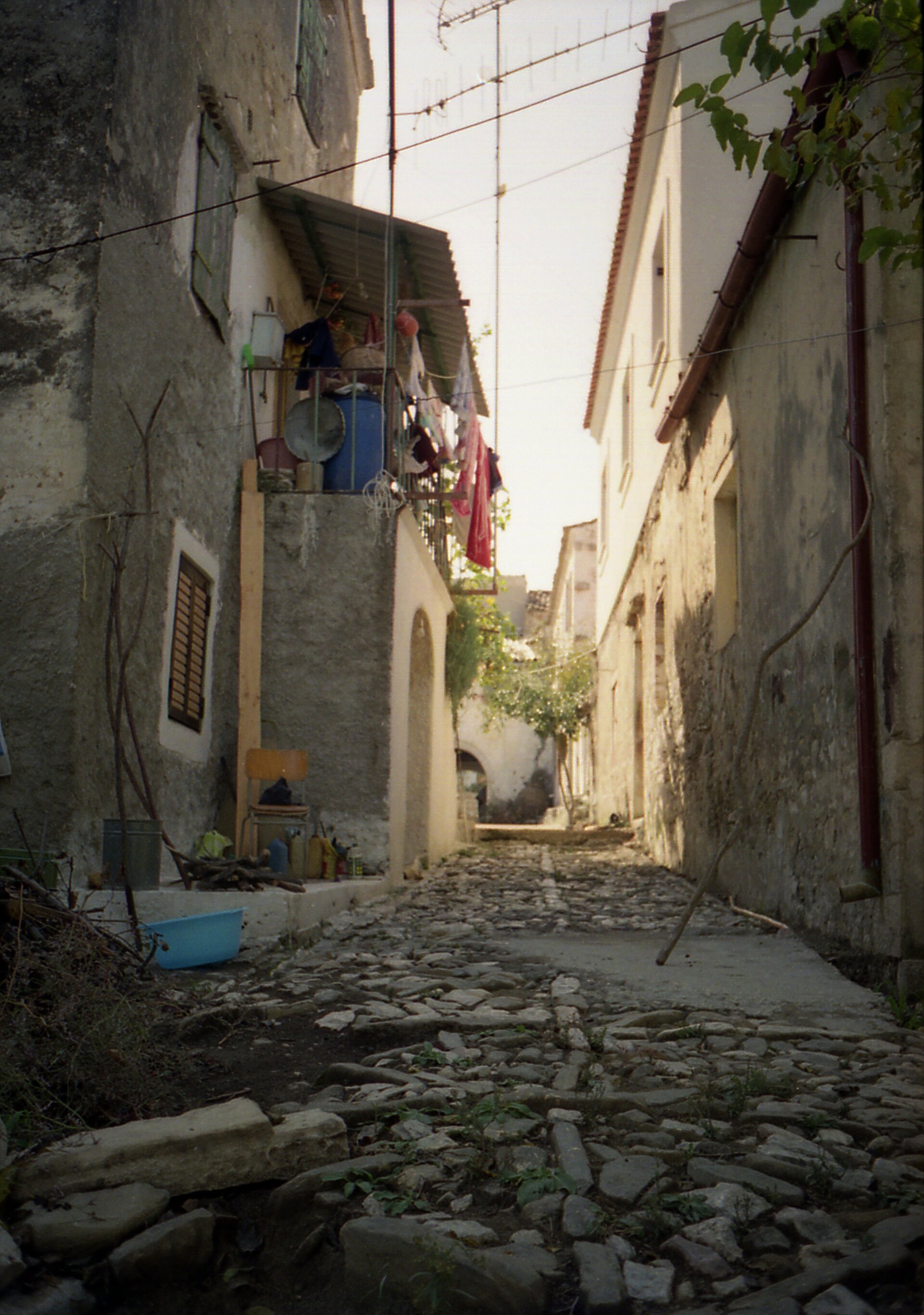
Strolling through Neokhoraki, what strikes you most is the consistency of its rural architecture. The houses, often built from local stone in warm honey and ochre tones, feature small wrought-iron balconies and external staircases leading to the upper floors, following a housing model that prioritised agricultural functionality. Many buildings still preserve the old olive presses or grain storehouses, today partly converted but still legible in their original structure. Getting lost among these lanes means discovering corners abloom with bougainvillea and jasmine, where the silence is broken only by the passing of a local resident or the song of cicadas on summer afternoons.
The surrounding nature: a sea of olive trees
The landscape surrounding Neokhoraki is dominated by an unbroken forest of centuries-old olive trees, some of which boast twisted, sculptural trunks that look like true works of natural art. Unlike the low-pruned olive groves of other Greek regions, those of Corfu grow tall and shady, creating a cool microclimate even on the hottest days. This green expanse gently slopes down towards the coast, offering numerous trails for hiking and cycling. Walking south, one can come across small wetlands and reed beds home to rich birdlife, making the area a paradise for birdwatching and nature photography enthusiasts.
The southern beaches: Marathias and Santa Barbara
Although Neokhoraki lies inland, its proximity to some of the island's most spectacular beaches makes it a strategic base. A few kilometres away lie the broad sandy stretches of Marathias and Santa Barbara (Maltas). These beaches are famous for their crystal-clear waters and shallow seabeds, ideal for families, but also for the wild, unspoilt stretches extending for kilometres. Here, unlike Corfu's rocky north, golden sand dunes and fiery sunsets that plunge directly into the Ionian Sea dominate, offering a natural spectacle of rare beauty every evening.
The Lefkimmi salt pans and the Korission Lagoon
In the immediate vicinity of Neokhoraki lies the area of the old Lefkimmi salt pans (Alykes), a site of great historical and environmental interest. Used since Venetian times for salt extraction, the salt pans are today a protected area where pink flamingos can be spotted during migration periods. Continuing north-west, one reaches the Korission Lagoon, a strip of water separated from the sea by high dunes and a forest of maritime cedars. It is a unique ecosystem in the Ionian Islands, where biodiversity reigns supreme and where one can follow trails suspended between fresh and salt water.
Gastronomic traditions and flavours of the land
Cuisine in Neokhoraki is a celebration of local produce. Extra virgin olive oil is the star ingredient, used to enhance historic dishes such as "Sofrito" (thin slices of veal cooked with garlic and parsley) or "Pastitsada" (pasta topped with rooster or beef in a rich spiced sauce). Around the village, small family-run taverns still serve fresh fish caught in the waters of Lefkimmi, prepared according to the recipe for "Bourdeto", a spicy fish soup that reflects the spiced soul of Corfiot cuisine. Local cheeses and full-bodied red wine produced in the vineyards of the southern area are also not to be missed.
What not to miss in Neokhoraki and the surrounding area
- A sunset stroll among the centuries-old olive groves surrounding the village.
- A visit to the Church of Agios Nikolaos to admire the eighteenth-century icons.
- An excursion to the nearby Lefkimmi salt pans for birdwatching.
- Dinner at a traditional tavern to taste authentic Corfiot Bourdeto.
- A relaxing day on the sandy dunes of Marathias beach.
- Exploring the village of Lefkimmi with its characteristic navigable canal.
When to go and how to experience the place
The best time to visit Neokhoraki is undoubtedly spring (May and June) or early autumn (September and October). In these months the temperatures are pleasant, nature is in full bloom or laden with fruit, and the beaches are not crowded. Summer is perfect for those seeking seaside life, but it is advisable to explore the village during the cooler hours. To fully experience the atmosphere of the place, it is recommended to rent a car or scooter, essential for getting around freely between the hamlets and the coast, and to take time to chat with locals in the "kafeneia" (traditional cafés), where the true soul of Corfu reveals itself over a Greek coffee or a glass of ouzo.
FAQ
Quanto tempo occorre per visitare Neokhoraki?
È un luogo adatto alle famiglie con bambini?
Ci sono parcheggi disponibili?
Qual è la spiaggia più vicina?
Getting there
- Aeroporto Internazionale di Corfù (CFU) - circa 40 km
- Non presenti sull'isola
- Da Corfù Città, seguire la strada costiera verso sud in direzione Lefkimmi. Neokhoraki si trova a pochi chilometri prima di raggiungere il centro di Lefkimmi.
- Se arrivate dalla Grecia continentale, è molto comodo il traghetto che arriva direttamente al porto di Lefkimmi, situato a soli 10 minuti dal villaggio.
Perfect for
Un borgo dove vivere la vera quotidianità greca, lontano dalle rotte del turismo di massa.
Circondato da uliveti millenari e vicino a riserve naturali e lagune protette.
Accesso rapido alle lunghe coste sabbiose del sud, tra le più selvagge dell'isola.
To see
What to see in Neokhoraki
Routes · Trovido Route
