

Milopotas
Overlooking the cobalt waters of the Aegean, Milopotas is not merely a beach, but the pulsating soul of the island of Ios, one of...
Updated 7 July 2026
This season · July · Summer
What to do in Milopotas now
The story
The story of Milopotas
A Journey Through Time: From Cycladic Origins to Homeric Myths
The history of Milopotas and the entire island of Ios traces its roots to the 3rd millennium B.C., when the archipelago became the hub of the refined Cycladic civilization. The island's strategic position, situated along maritime routes between Crete and mainland Greece, made it a crucial port for traders of antiquity. During the Classical era, Ios was inextricably linked to Homer: tradition holds that the great poet died here during a journey to Athens. In the Middle Ages, the island came under the control of the Duchy of Naxos and the Venetian Crispo family, who fortified the settlement to protect it from pirate raids. This was followed by the long Ottoman domination, which ended only with the Greek War of Independence. This cultural stratification remains visible in local architecture, where Cycladic simplicity merges with Venetian and Byzantine memories.
The Beach of Milopotas: A Kilometer of Golden Sand
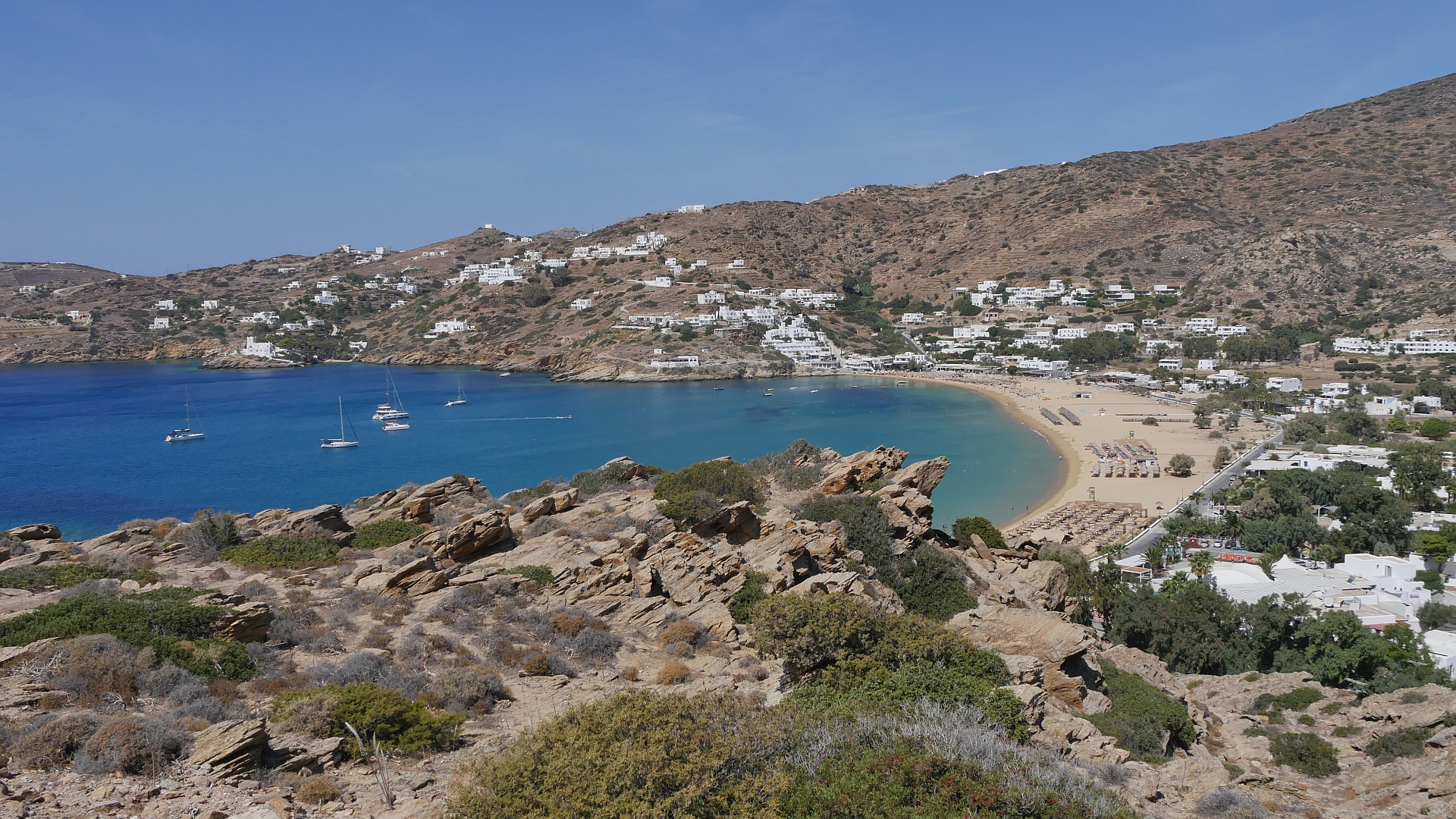
The nerve center of the locale is undoubtedly its beach, considered one of the most beautiful in the entire Aegean. Roughly a kilometer long, Milopotas Bay stands out for its finest sand and waters that slope gently, taking on hues ranging from turquoise to deep blue. Protected from dominant winds by the surrounding hills' configuration, the beach offers a safe and crystalline environment, regularly awarded the Blue Flag. Beyond relaxation, Milopotas is an excellence hub for water sports: from windsurfing to diving to paddle boarding, activities never run short. Despite its popularity, the vastness of the sandy expanse allows for pockets of relative quiet, especially at the bay's extremities, where rocky formations create small natural pools ideal for snorkeling.
Skarkos: The Bronze Age Settlement
A short distance from Milopotas lies one of the Cyclades' most significant archaeological sites: Skarkos. Situated on a hill overlooking the harbor, this settlement dating from the Proto-Cycladic II period (approximately 2700-2300 B.C.) is extraordinarily well preserved. Excavations have revealed a complex urban system, with two-story buildings, courtyards, and a sophisticated drainage system. Walking among Skarkos's remains allows one to understand daily life over four thousand years ago, admiring the precision with which dry stone walls were constructed and the organization of communal spaces. The site received the Europa Nostra award for excellence in restoration, testifying to the worldwide importance of this place that serves as a direct bridge to the origins of European civilization.
The Chora of Ios: The White Labyrinth Above the Bay
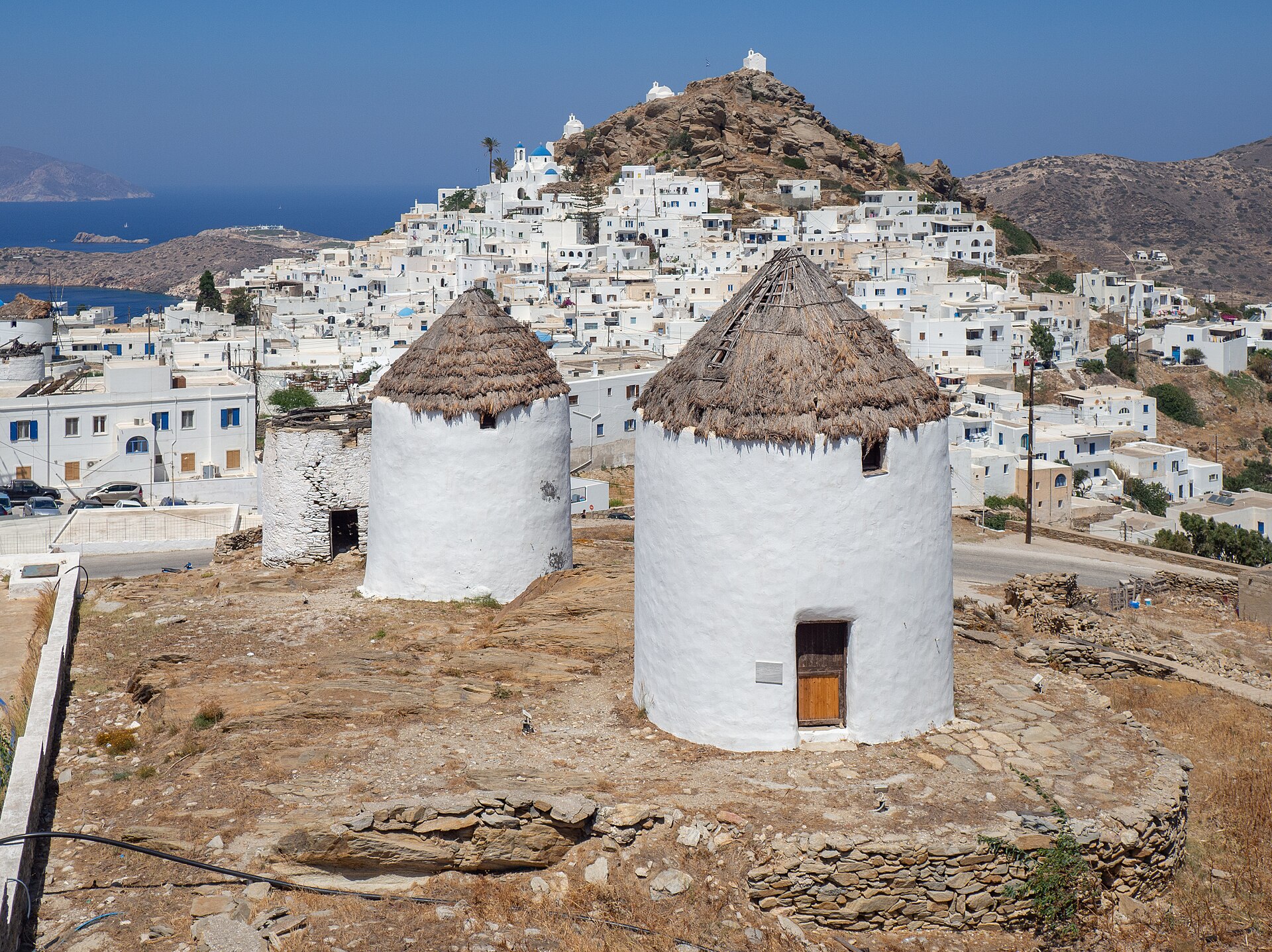
Perched on a hill overlooking Milopotas, the Chora is the perfect example of a traditional Cycladic village. It is a maze of narrow, winding alleys, originally designed to confuse pirates and protect inhabitants from strong summer winds. The houses, strictly whitewashed with lime, feature doors and windows painted in various shades of blue, often adorned with cascades of fuchsia bougainvillea. Strolling through the Chora one encounters hidden squares, steep staircases, and numerous small churches with luminous domes. While the village appears as an oasis of peace and quiet during the day, as the sun sets it transforms into the social hub of the island, with cafes, taverns, and bars animating the nights without detracting from the architectural charm of the place.
Panagia Gremiotissa: The Island's Sentinel
The Chora's most iconic point, visible even from Milopotas, is the church of Panagia Gremiotissa. Located at the village's summit, this church owes its name to the Greek word 'gremos' (cliff), as it stands right on the edge of a rocky spur. Legend recounts that the icon of the Virgin housed within miraculously arrived from Crete during Ottoman rule. Characterized by an intense blue dome and an elegant bell tower, the church is surrounded by three palms that make it immediately recognizable. Beyond its religious significance, this location offers the island's most spectacular sunset: from here the gaze spans the entire Aegean, embracing the nearby islands of Sikinos and Santorini in a burst of warm colors.
Homer's Tomb at Plakotos
For lovers of classical myths, a visit to the reputed Tomb of Homer is a must. Located in the Plakotos area, at the island's northern extremity and reachable by a brief car journey from Milopotas, the tomb sits on an isolated hill overlooking the open sea. Though no definitive archaeological evidence confirms the poet's burial here, tradition is so deeply rooted that the site has become a place of literary pilgrimage. The monument consists of a series of stacked stones forming a sort of mound, surrounded by wild, wind-swept nature. The atmosphere at Plakotos is steeped in ancient solemnity, a place where silence is broken only by the sound of waves below, paying homage to the greatness of the father of epic.
The Odysseas Elytis Theatre: Marble and Poetry
Constructed in ancient style but completed only in 1997, the Odysseas Elytis Theatre is a tribute to the Greek Nobel Prize winner for literature. Built entirely in white marble and local stone, the theatre sits in an extraordinary panoramic position, facing south with breathtaking views of Milopotas Bay. Its architecture perfectly echoes the structure of ancient Greek theaters, ensuring impeccable acoustics. During summer, the theatre hosts concerts, theatrical performances, and cultural festivals, allowing spectators to enjoy artistic performances under the starlit Cycladic sky. It is a place where modernity meets classical tradition, celebrating the continuity of Hellenic culture through the millennia.
Nature and Landscape: The Wild Interior
Beyond the beaches, the territory around Milopotas offers a harsh yet captivating landscape, typical of the central Aegean islands. The interior is characterized by barren hills, interspersed with dry stone walls delimiting ancient agricultural terraces. Vegetation consists mainly of aromatic herbs such as thyme, oregano, and sage, which perfume the air during the hottest hours. For trekking enthusiasts, trails connect Milopotas to other more remote bays, such as those of Manganari or Agia Theodoti, offering panoramic glimpses of the jagged coastline. The island's geology, predominantly composed of metamorphic rocks, gifts spectacular sea cliffs, where various species of migratory birds nest, making the area interesting for birdwatching as well.
Traditions and Flavors: The Cuisine of Ios
The gastronomic culture of Ios is a triumph of authentic and genuine flavors. One of the most celebrated products is 'Skotyri' cheese, a pungent and creamy goat or sheep cheese, often flavored with local herbs. The island's thyme honey is renowned for its purity and intensity, and is the main ingredient in 'Pasteli' (sesame bar) and 'Loukoumades' (sweet fritters). In Milopotas's taverns, fresh fish cannot be missed, simply grilled, or 'Revithada', a lentil stew slowly cooked in wood-fired ovens. Religious celebrations, or 'panigiria', are the perfect occasion to discover traditional dances and the music of violin and lute, sipping the local wine which, despite the arid climate, retains a surprising structure and aroma.
Experiences Not to Miss in Milopotas
- Watch the sunset from the church of Panagia Gremiotissa in the Chora.
- Take a boat excursion to explore sea caves and coves accessible only by water.
- Visit the Skarkos archaeological site for an immersion in Cycladic prehistory.
- Taste Skotyri and local honey in one of the traditional taverns.
- Practice windsurfing or paddle boarding in the bay's crystalline waters.
- Attend a theatrical performance at the Odysseas Elytis Theatre under the stars.
- Walk to Homer's Tomb to enjoy the solitary view over Plakotos.
When to Visit and How to Experience the Place
The ideal time to visit Milopotas depends on the type of experience desired. The months of July and August are the hottest and most crowded, perfect for those seeking vibrant nightlife and a cosmopolitan atmosphere. If you prefer tranquility and wish to fully enjoy nature and silence, June and September are extraordinary: temperatures are pleasant, the seawater is warm, and services are all active without the pressure of mass tourism. Spring is magical for those who love trekking, as the island becomes tinted with green and wildflowers. To experience Milopotas like a local, the advice is to start the day early with a refreshing swim, dedicate the central hours to discovering historical sites, and conclude the evening in the Chora, allowing yourself to be guided by the scents of traditional cuisine.
FAQ
Come si raggiunge la spiaggia di Milopotas dalla Chora?
La spiaggia di Milopotas è adatta alle famiglie con bambini?
È necessario noleggiare un'auto a Milopotas?
Dove si può parcheggiare vicino alla spiaggia?
Milopotas è una località molto rumorosa la notte?
Getting there
- Aeroporto di Santorini (JTR) - poi traghetto (circa 45-90 min)
- Aeroporto di Atene (ATH) - poi traghetto dal Pireo (3-7 ore)
- Non presenti sull'isola
- Da Gialos (porto) seguire le indicazioni per Chora e poi proseguire verso sud per circa 2 km lungo la strada costiera asfaltata.
- Prenotate i traghetti in anticipo durante l'alta stagione, specialmente le rotte veloci da Santorini o Mykonos.
Perfect for
Ideale per chi cerca una spiaggia ampia, attrezzata e con acque cristalline, tra le migliori delle Cicladi.
Un luogo magico che unisce l'insediamento preistorico di Skarkos alla leggendaria tomba del poeta Omero.
Perfetta per i giovani e per chi ama divertirsi, grazie alla vicinanza con i celebri club della Chora e i beach bar.