

Psirri
Venturing into the streets of Psirri means crossing an invisible threshold where monumental, marble Athens gives way to a more vis...
Updated 7 July 2026
This season · July · Summer
What to do in Psirri now
The story
The story of Psirri
A story of rebellion and rebirth
The origins of Psirri are lost in the centuries, but it was in the 19th century that the neighborhood assumed a strong and controversial identity. After Greece's independence, it became the refuge of the so-called 'Koutsavakides', legendary figures known for their long mustaches, wide-brimmed hats, and a code of honor as strict as it was violent. These men, often armed and in constant defiance of authority, made Psirri a 'no-go' zone for the police of the time, transforming it into a kind of anarchic enclave in the heart of the city. It was only towards the end of the 19th century that the government managed to normalize the area, which gradually became the center of Athenian artisanal production. Shoemakers, tanners, and blacksmiths established their workshops here, defining the architecture of the low buildings with internal courtyards that still characterize the urban landscape today. In the post-World War II period, the neighborhood experienced a period of decline, only to be reborn in the 1990s as a cultural hub and nightlife center.
Plateia Iroon: the beating heart of the neighborhood
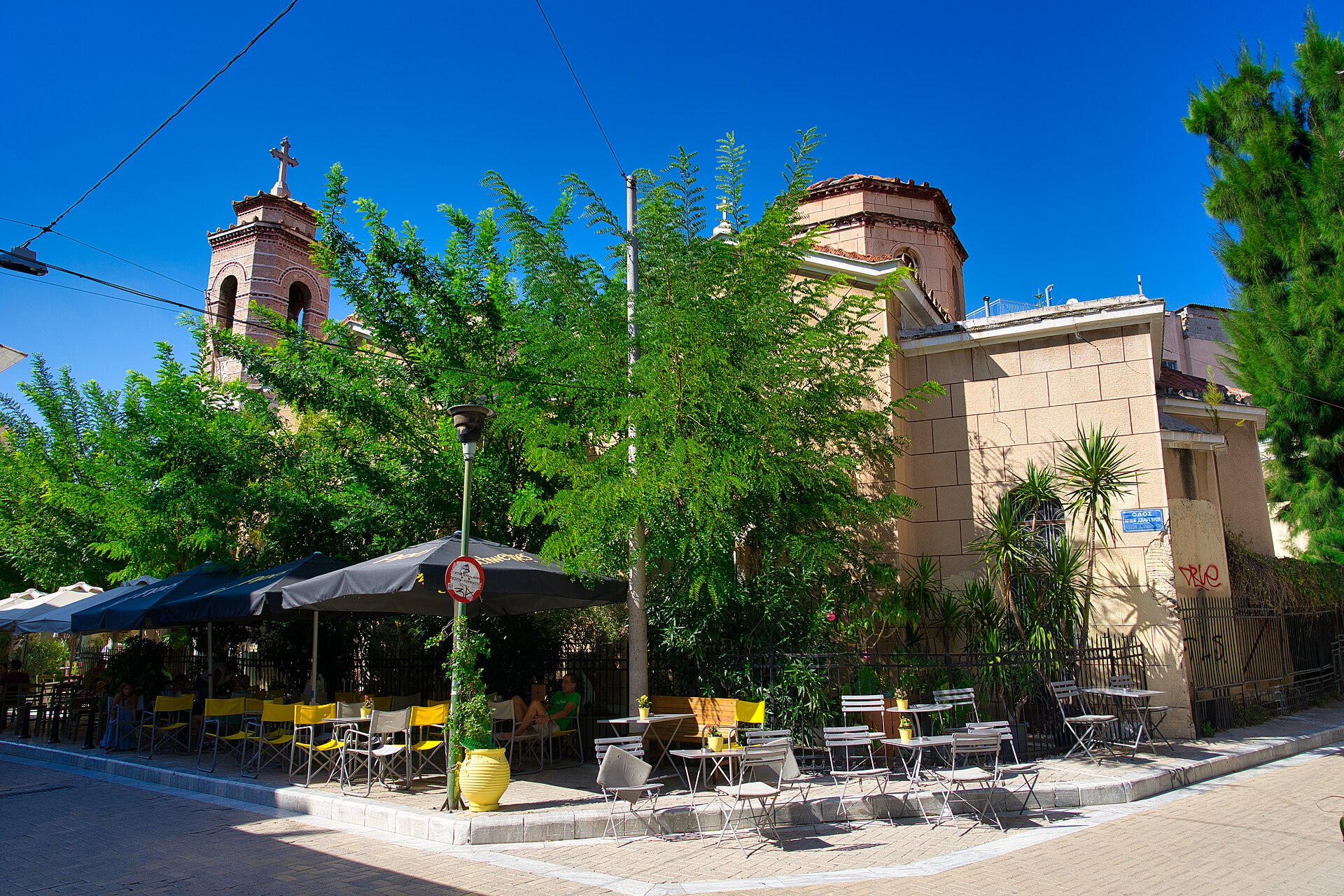
Plateia Iroon, or Heroes' Square, is the geometric and spiritual center of Psirri. The name is no coincidence: it refers to the fighters of the Greek War of Independence who once frequented these streets. Today, the square is a vibrant crossroads where daily life manifests itself in all its liveliness. Surrounded by small cafes and historic tavernas, it is the ideal place to observe people passing by and breathe in the neighborhood's atmosphere. The streets branching off from the square are a maze of alleys where it's easy to lose your bearings, but it's precisely in this disorientation that the most fascinating details are discovered: old wrought-iron signs, monumental murals covering entire facades, and small votive altars hidden in the most unexpected corners. The square serves as a natural stage for street musicians and artists, keeping alive the community spirit that has always characterized Psirri.
The Church of Agioi Anargyroi
Erected on foundations dating back to the Byzantine era, the Church of Agioi Anargyroi (Saints Cosmas and Damian) represents one of the most significant architectural and religious landmarks of the neighborhood. This sacred building, with its characteristic dome and light stone walls, offers an oasis of silence and spirituality amidst the surrounding creative chaos. The church is linked to deep popular devotion, as the saints to whom it is dedicated are the 'healing saints' who cured without asking for compensation. Inside, the atmosphere is intimate, illuminated by the glow of candles and decorated with icons that tell centuries of Orthodox faith. The church courtyard is often used for local celebrations, serving as a unifying force for the resident community which, despite gentrification, maintains a strong connection to its religious and social traditions.
The legacy of artisans and the leather street
Despite its transformation into a trendy neighborhood, Psirri jealously guards its manufacturing soul. Walking along streets like Agiou Dimitriou or Sarri, it is still possible to stumble upon small workshops where time seems to have stood still. Here, third or fourth-generation artisans work leather using ancient techniques, producing sandals, bags, and accessories that are the pride of local production. Entering these workshops means being enveloped by the pungent scent of tanned leather and the rhythmic sound of hammers. This historical continuity is what makes Psirri special: it is not a static museum, but a neighborhood where manual labor coexists with modern art galleries. Many of the old industrial warehouses have now been converted into lofts or design studios, creating a fascinating dialogue between the industrial aesthetic of the past and new creative trends.
Street Art: an open-air gallery
Psirri is internationally known for being one of the most dynamic districts for street art in Europe. Every wall, shutter, or blind corner becomes a canvas for local and international artists who use the language of graffiti to express political, social, or purely aesthetic messages. One of the most famous murals is dedicated to 'Loukanikos', the stray dog that became a symbol of the Greek protests, but the entire neighborhood is dotted with works ranging from photorealism to abstract art. This explosion of colors and forms contributes to giving Psirri that 'edgy' and contemporary character that attracts young people and creatives from all over the world. Exploring the neighborhood in search of urban artworks is an alternative way to discover hidden corners that would otherwise go unnoticed, making every walk a constantly new and surprising visual experience.
The dreamy atmospheres of Pittaki Street and Little Kook
In recent years, Psirri has seen the emergence of urban installations that have redefined some of its corners. Pittaki Street, once a dark and little-frequented alley, has been transformed by a creative lighting project that saw the installation of hundreds of vintage chandeliers and lampshades donated by citizens, creating a luminous ceiling that enchants at sunset. Not far away, the Little Kook cafe has brought a touch of surrealism to the neighborhood: entire facades and adjacent streets are extravagantly decorated according to seasonal themes (such as Alice in Wonderland or Christmas), transforming the area into a film set. Although these attractions are more geared towards modern tourism, they demonstrate Psirri's ability to play with its own image and integrate fantastic elements into its historic urban fabric.
Unmissable experiences in Psirri
- Enjoy a warm portion of Bougatsa from 'Bougatsa Tou Sarri', a local institution for those who love cream-filled pastry.
- Get lost among the historic shoemakers' workshops to buy a pair of handmade leather sandals.
- Search for the most hidden murals by following a guided tour dedicated to Athenian street art.
- Spend an evening in a 'mezedopolio' listening to live rebetiko music while sipping ouzo or tsipouro.
- Admire the luminous installations of Pittaki Street after sunset.
- Visit the Church of Agioi Anargyroi to discover the more spiritual side of the neighborhood.
Culinary traditions and popular flavors
Cuisine in Psirri is a matter of substance and conviviality. The neighborhood is famous for its traditional tavernas where the concept of 'meze' (small dishes to share) reigns supreme. Here you can taste specialties rooted in the most authentic Greek tradition: spiced meatballs (keftedakia), grilled local cheeses (saganaki), and fresh salads dressed with Attica olive oil. But Psirri is also the realm of sweets: in addition to the aforementioned bougatsa, the area's pastry shops offer loukoumades (honey fritters) and galaktoboureko that attract sweet tooths from all over the city. In the evening, the atmosphere warms up and the tavernas fill with music; it's not uncommon to find yourself dining next to musicians playing the bouzouki, making the meal a complete cultural experience that celebrates the pleasure of food and company.
When to go and how to experience the neighborhood
Psirri is a neighborhood that changes its skin depending on the time of day. Morning is the best time to explore the artisanal side and shop in the workshops, when activity is bustling and residents are doing their shopping. Late afternoon, with the golden light hitting the neoclassical facades, is perfect for photography and enjoying an outdoor coffee. However, it is at night that Psirri reveals its most festive soul: bars fill up, lights turn on, and the neighborhood becomes the center of Athenian nightlife, while maintaining a more relaxed and less pretentious atmosphere compared to other areas of the city. The ideal seasons to visit are spring and autumn, when temperatures allow for long walks and enjoying outdoor tables without the summer heat, although winter also retains a particular charm thanks to the density of cozy venues.
FAQ
Psirri è un quartiere sicuro per i turisti?
Quanto tempo serve per visitare il quartiere?
È adatto alle famiglie con bambini?
Qual è la fermata della metropolitana più vicina?
Getting there
- Aeroporto Internazionale di Atene Eleftherios Venizelos (ATH) - circa 35 km
- Stazione Metro Monastiraki (Linea Blu M3 dall'aeroporto, Linea Verde M1 dal Pireo)
- Psirri è una zona a traffico limitato e con strade molto strette; si consiglia di lasciare l'auto nei parcheggi custoditi vicino a Piazza Omonia o Monastiraki.
- Il modo migliore per esplorare Psirri è rigorosamente a piedi; il quartiere è compatto e ogni vicolo nasconde dettagli che si perderebbero con qualsiasi mezzo.
Perfect for
Un viaggio tra passato ribelle e architettura neoclassica, perfetto per chi ama la storia urbana meno convenzionale.
Una delle destinazioni europee più importanti per l'arte urbana, con murales di alto livello in ogni angolo.
Il paradiso dei sapori greci autentici, dalle colazioni a base di bougatsa alle cene animate dal rebetiko.
Un distretto vibrante che offre dai bar underground ai caffè a tema, ideale per chi cerca divertimento autentico.
To see
Da vedere a Psirri
Routes · Trovido Route
